Carlos Delgado

Quick Answer
An admissions chatbot answers questions. An AI sales agent drives action. Chatbots are reactive, they wait for a prospective student to ask something. AI sales agents are proactive, they reach out, qualify leads, handle objections, and book calls. For universities serious about enrolment, the distinction isn't semantic. It's the difference between a 2% and a 25% lead-to-call conversion rate.
Every admissions team has heard the pitch: "Just add a chatbot to your website and let it handle enquiries."
And on the surface, it sounds reasonable. A chatbot can answer questions about application deadlines, tuition fees, and entry requirements, freeing up your advisors for higher-value work.
But here's the problem: answering questions is not the same as converting leads.
The vast majority of prospective students who enquire about your programmes never book a discovery call. Not because they weren't interested, but because no one followed up at the right moment, in the right way, with the right message.
A chatbot can't fix that. An AI sales agent can.
This post breaks down exactly what separates the two, why it matters for your admissions funnel, and what to look for if you're evaluating solutions for your institution.
What an Admissions Chatbot Actually Does
Admissions chatbots are designed around one primary function: answering inbound questions.
A prospective student lands on your website, clicks the chat widget, and types something like "What are the entry requirements for your MBA?" The chatbot retrieves the answer from a knowledge base and replies.
That's useful. But it's fundamentally reactive.
Chatbots:
Wait for the student to initiate contact
Respond to questions already being asked
Provide information that's often available on your website anyway
Have no follow-up capability once the chat ends
Cannot qualify a lead or assess enrolment intent
Do not connect to your CRM or calendar
The chatbot interaction ends, the student closes the tab, and that lead is gone. No follow-up. No qualification. No call booked.
According to research published in the Harvard Business Review by Oldroyd et al. (2011), companies that follow up with leads within one hour are 7x more likely to qualify them than those that wait even a few hours. Most admissions chatbots have no mechanism to act on this window.
What an AI Sales Agent Does Differently
An AI sales agent is built around a completely different objective: converting enquiries into booked calls.
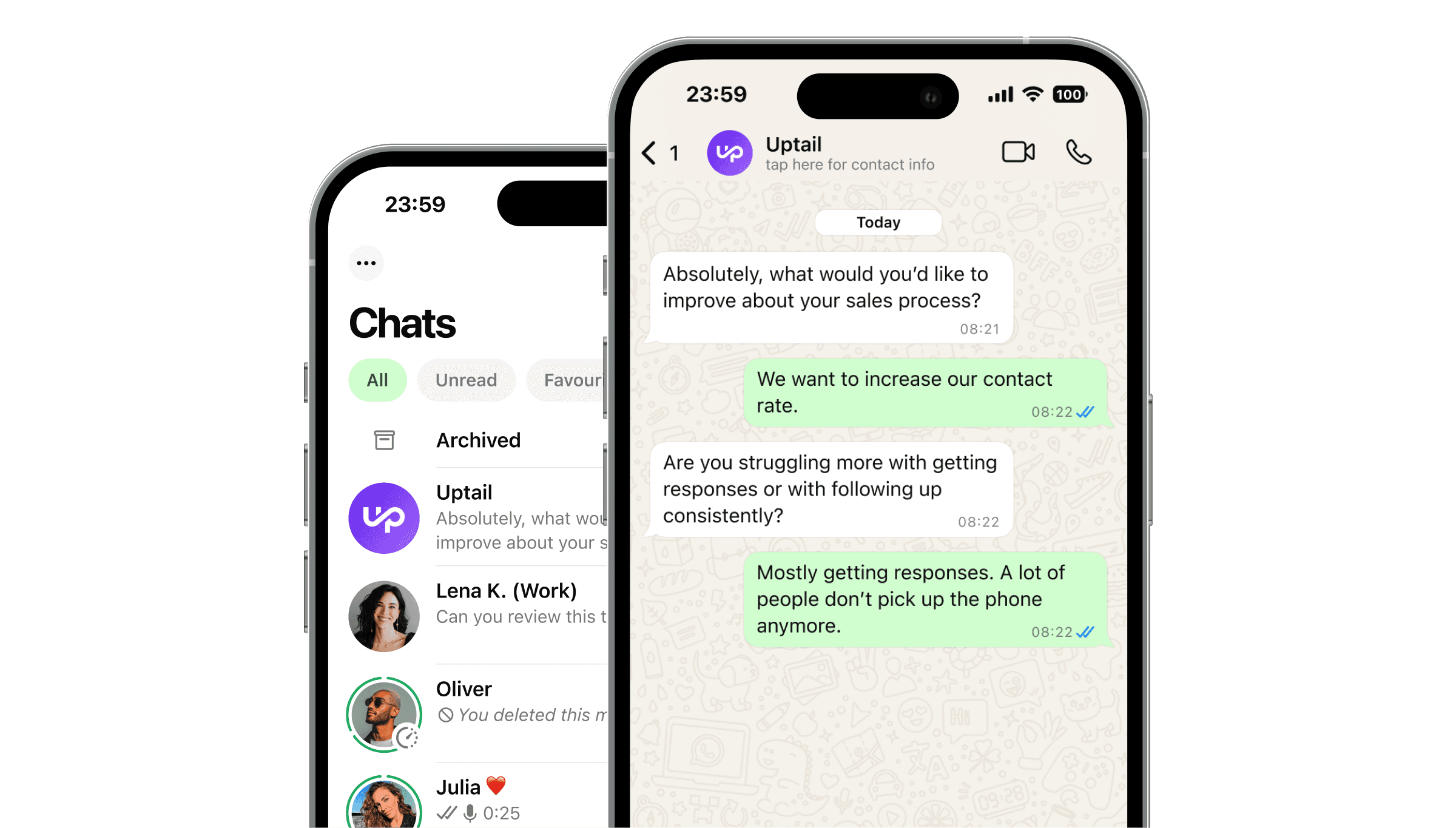
Instead of waiting for a student to ask a question, the AI sales agent proactively reaches out, via WhatsApp, SMS, or email, the moment an enquiry comes in. It introduces itself, asks qualifying questions, handles objections, and guides the student toward booking a call with an admissions advisor.
The 5 Key Differences
Capability | Admissions Chatbot | AI Sales Agent |
|---|---|---|
Initiates outreach | No, waits for student to start chat | Yes, proactively contacts enquiries via WhatsApp/SMS/email |
Qualifies leads | No, provides information only | Yes, asks discovery questions to assess fit and intent |
Books discovery calls | No, directs students to a booking page at best | Yes, offers specific slots and confirms the booking in-conversation |
Follows up on cold leads | No, conversation ends when the student leaves | Yes, re-engages leads that went cold over days or weeks |
Integrates with CRM/calendar | Rarely, and usually limited | Yes, syncs qualified leads and booked calls directly |
Why the Distinction Matters for Enrolment
The gap between a chatbot and an AI sales agent isn't a feature gap, it's a conversion gap.
Let's look at a typical admissions funnel. An institution generates 1,000 enquiries per month. Of those:
A chatbot might handle inbound FAQs for 20–30% of them
But it books zero calls proactively
Human advisors follow up manually with a fraction of leads, typically within 24–72 hours
Net result: a 3–5% lead-to-call conversion rate is common
With an AI sales agent:
First outreach happens within 60 seconds of the enquiry
The agent qualifies leads and filters out low-intent contacts before advisors get involved
Call booking rates of 20–35% of qualified leads are achievable (Uptail platform data)
Advisors only spend time on leads that have been pre-qualified and have confirmed interest
When a Chatbot Is Enough, and When It Isn't
To be fair: chatbots do have a role in admissions.
If your primary goal is reducing inbound FAQ volume, questions about deadlines, fees, entry requirements, a well-configured chatbot handles this efficiently. It's available 24/7, requires no human oversight, and reduces the administrative load on your team.
But if your goal is increasing enrolment, a chatbot alone won't move the needle. The conversion problem in admissions isn't an information problem. Prospective students can find most information on your website. The problem is engagement, getting them to take the next step before interest fades.
That's a sales problem. And it requires a sales tool.
Use a chatbot when:
You want to reduce inbound FAQ volume on your website
You're handling high volumes of basic administrative enquiries
You want 24/7 availability for simple information requests
Use an AI sales agent when:
You want to increase lead-to-call conversion rates
You're losing leads because follow-up is slow or inconsistent
You want to qualify leads before they reach your advisors
You're running paid campaigns and need fast follow-up to protect ROAS
What to Look for in an AI Sales Agent for Admissions
Not all AI sales agents are built for higher education. When evaluating options, these are the capabilities that matter most for an admissions context:
Programme knowledge depth
The agent needs to handle nuanced questions about specific programmes, not just generic institution-level information. An enquiry about a part-time MBA requires different qualification questions than an enquiry about a full-time MSc.
Multi-channel outreach
Prospective students, particularly international students, are most responsive on WhatsApp. An agent limited to email or website chat will miss a large share of your audience.
Qualification logic
The agent should ask questions that map to your actual admissions criteria: work experience, educational background, start date, visa status, funding situation. Generic qualification flows produce low-quality handoffs.
Human escalation handling
The agent needs to recognise when a conversation exceeds its scope, complex funding questions, special circumstances, appeals — and escalate cleanly to a human advisor without the student noticing a drop in quality.
CRM and calendar integration
Qualified leads and booked calls should sync automatically to your CRM and advisor calendars. Manual data entry defeats the purpose.
Frequently Asked Questions
Can I use both a chatbot and an AI sales agent?
Yes, and many institutions do. A chatbot handles inbound FAQ traffic on the website, while an AI sales agent handles proactive outreach and lead qualification for enquiries that come through forms, ads, or events. The two serve different parts of the funnel.
Will prospective students know they're talking to an AI?
Most AI sales agents are transparent about being AI-assisted. Uptail's agents are designed to be conversational and helpful rather than to pass as human, which tends to build trust rather than undermine it. Students generally respond well when the agent is fast, relevant, and genuinely useful.
How long does it take to set up an AI sales agent for admissions?
Setup time varies by provider, but a well-scoped implementation, including programme knowledge base, qualification logic, and CRM integration, typically takes 2–4 weeks. The primary input required from your team is a clear brief on what a qualified lead looks like and which programmes to prioritise.
What's a realistic conversion rate improvement?
Institutions using Uptail's AI sales agent typically see lead-to-call conversion rates of 20–35% on qualified leads, compared to 3–8% with manual follow-up. Results vary based on lead quality, programme competitiveness, and how quickly the agent reaches new enquiries.
Does an AI sales agent work for international student recruitment?
Yes — in many ways it's better suited to international recruitment than domestic. International students are often in different time zones, making real-time human response difficult. They're also typically WhatsApp-native, and they often have more questions about visa, scholarship, and accreditation. An AI agent handles all of these consistently, at any hour.