Carlos Delgado

Quick Answer
A fully loaded admissions advisor costs around £45,000–£55,000 per year, covers roughly 1,600 hours, and responds during business hours only. An AI sales agent costs £1,500–£4,000 per month, responds in under 60 seconds at any hour, and handles unlimited concurrent conversations. The right question isn't which is cheaper, it's which one you're currently using for the wrong jobs.
When an admissions team is stretched, the instinct is to hire. Another advisor, another coordinator, a call centre during peak season. It feels like the responsible answer. But in 2026 there's a direct alternative with a different cost structure, different capabilities, and a different failure mode. Before you post the next job listing, it's worth doing the comparison properly.
The True Cost of an Admissions Hire
A mid-level admissions advisor costs between £28,000 and £38,000 in base salary. Factor in employer National Insurance, pension, equipment, onboarding, and management time, and the fully loaded cost lands at £45,000–£55,000 per year.
That buys you:
Roughly 1,600 working hours per year: after holidays, sick leave, and training
9am–5pm coverage, Monday to Friday, on most days
30–60 inbound inquiries handled per day before quality and response time degrade
Response times that depend entirely on workload: often 2–4 hours during peak periods
The cost isn't the core problem. The problem is that inquiry volume doesn't arrive in a steady stream.
Monday mornings, post-open-day rushes, application deadline weeks, these create spikes that a fixed-size team cannot absorb without delay. And delay is where leads go cold.
The True Cost of an AI Sales Agent
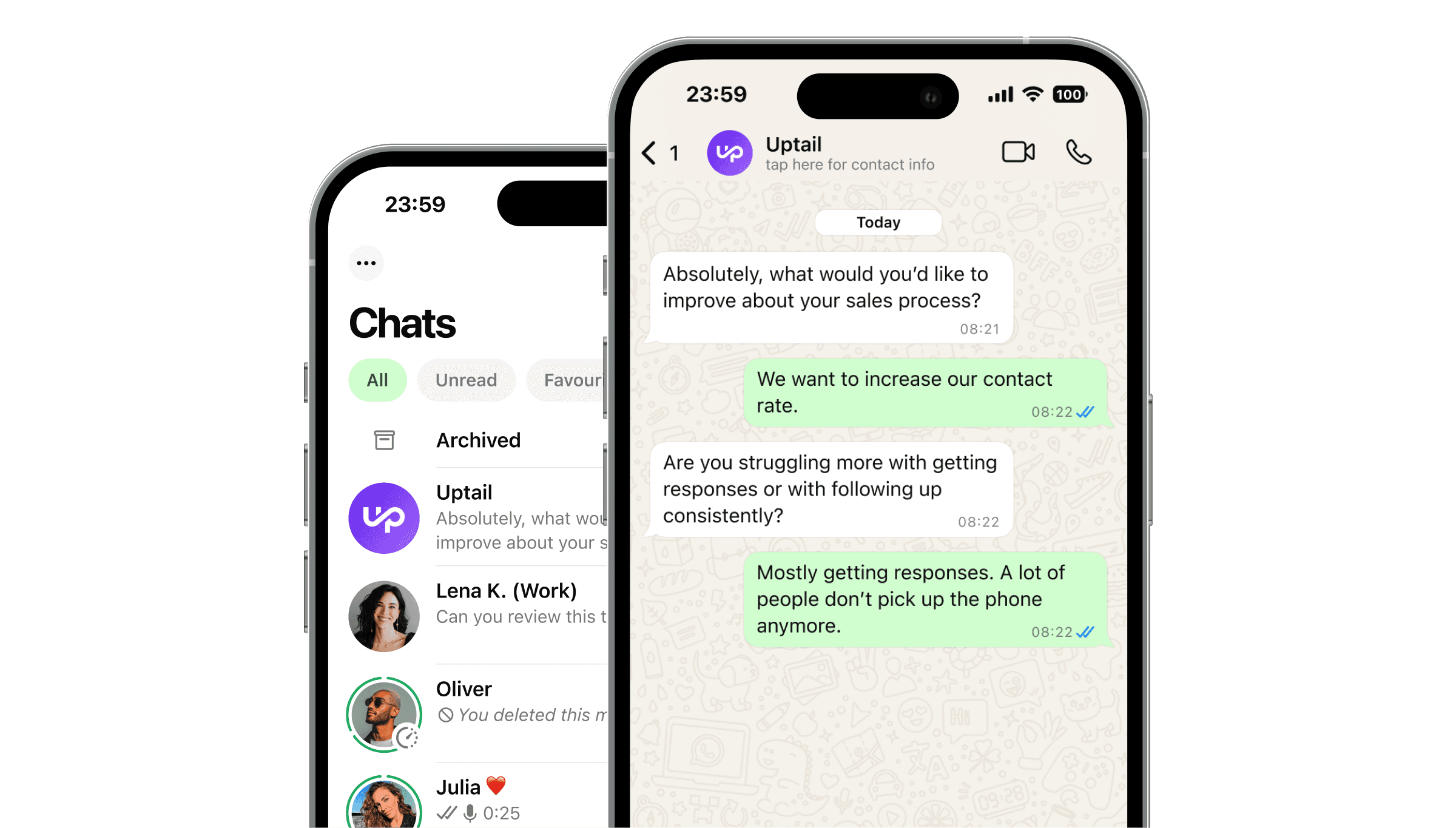
An AI sales agent handles inbound WhatsApp inquiries, qualifies prospective students through conversation, answers programme questions, and books advisor calls, automatically, around the clock.
Typical pricing in 2026 sits between £1,500 and £4,000 per month depending on conversation volume and configuration depth. Some providers (including Uptail) work on a performance model tied to qualified leads or booked calls rather than a flat subscription.
That buys you:
Unlimited concurrent conversations: no queue, no wait time
24/7 coverage including evenings, weekends, and bank holidays
Sub-60-second response time on every inbound inquiry, every time
Consistent qualification logic applied uniformly across every lead
Full conversation logs synced to your CRM before any advisor picks up the phone
Where the Numbers Get Interesting
At face value, £45,000–£55,000 per year (hire) versus £18,000–£48,000 per year (AI agent) can look like a wash. That comparison misses the operational difference.
A human advisor handles one conversation at a time. An AI agent handles hundreds simultaneously. During the 72 hours after a major open day, an AI agent processes every inbound inquiry at the same speed it handles one. A human team cannot.
More importantly: speed to first contact is the single biggest variable in lead conversion. Research shows that firms contacting leads within five minutes are 100x more likely to make contact than those waiting 30 minutes, and 21x more likely to qualify the lead (InsideSales Lead Response Management Study).
Separately, companies responding within one hour are nearly 7x more likely to qualify a lead than those responding later (Oldroyd et al., Harvard Business Review, 2011). An AI agent wins this by default. A human team almost never can during peak periods.
Side-by-Side Comparison
Factor | Human Advisor | AI Sales Agent |
|---|---|---|
Annual cost (fully loaded) | £45,000–£55,000 | £18,000–£48,000 |
Response time | Minutes to hours (workload-dependent) | Under 60 seconds, always |
Coverage hours | Business hours only | 24/7 including weekends |
Concurrent conversations | 1 | Unlimited |
Performance during volume spikes | Degrades significantly | Consistent |
Complex conversation handling | Strong | Limited to configured scenarios |
Relationship building and empathy | Strong | Not a replacement |
What the AI Agent Doesn't Replace
This comparison is not an argument for eliminating your admissions team. It's an argument for redeploying them.
An AI sales agent handles the top of the funnel: first contact, qualification, programme FAQs, and call booking. It delivers prospective students to the right advisor with full context already captured.
The advisor's job, building rapport, handling nuanced financial concerns, addressing personal circumstances, making the case for your institution, remains irreducibly human. The AI makes that conversation better by eliminating the discovery phase entirely.
The real question isn't AI versus staff. It's: what is each one best at, and are you currently using them that way?
Sample Conversation: AI Agent During a Monday Morning Spike
Prospective student: Hi, I saw your postgraduate nursing programme. Can you tell me more about the entry requirements?
AI Agent: Hi [Name], thanks for reaching out. The MSc Nursing requires a 2:2 or above in a related healthcare degree, plus current NMC registration for the clinical pathways. Are you currently registered, or are you coming from a different background?
Prospective student: I'm registered, been working as a band 5 for two years.
AI Agent: That's a strong fit, most of our students come in at band 5 or 6. The next intake is September, with an application deadline of 31 July. Would it help to have a 20-minute call with one of our advisors to go through funding options and the application? I can check availability now.
This conversation happened at 8:47am on a Monday, while your advisors were still logging in.
Frequently Asked Questions
Does an AI sales agent fully replace admissions advisors?
No. An AI agent handles top-of-funnel work: first contact, qualification, FAQs, and call booking. Complex financial conversations, emotional support, and persuasion remain human work. The AI makes advisors more effective by delivering better-qualified leads with full context already captured.
What happens when the agent can't answer a question?
A well-configured agent recognises its limits and escalates to a human advisor rather than guessing. Escalation triggers, financial disputes, visa questions, expressions of frustration, should be defined explicitly during setup.
How long does deployment take?
Typically 3–6 weeks from scoping to go-live, depending on programme complexity and CRM integration requirements.
Is performance-based pricing better than a subscription?
Performance pricing (per qualified lead or booked call) works well for institutions with variable inquiry volume. Subscription pricing is more predictable at high volume. Both models exist in the market.
Can the agent handle inquiries about multiple programmes simultaneously?
Yes. A properly configured agent differentiates between programmes, routes qualification accordingly, and knows the entry requirements, fees, intake dates, and key differentiators for each.