Carlos Delgado

A lead spike is what every marketing team prays for. A launch lands, a campaign goes viral, a seasonal peak arrives, and the inbound funnel floods in a single afternoon.
Then the playbook breaks. Reps drown, reply times blow past 10 minutes, and the leads that cost the most to acquire are the first to go cold.
Most teams assume the fix is more headcount, but its not. The fix is a system built to absorb 10–50× normal volume without touching rep capacity.
Quick Answer
Handling high-volume inbound leads is the practice of scaling first-response and qualification capacity on WhatsApp without scaling the sales team, by using an AI agent to instantly reply, qualify, and book every new lead, while a real-time scoring model routes only the highest-intent conversations to human reps. The result is sub-minute response times even during 10–50× spikes, without missed leads or burnout.
How AI-First Lead Handling Differs from Human-Only Lead Handling
Both approaches aim at the same outcome: qualified conversations with real humans. They diverge the moment volume moves off baseline.
Human-Only Handling | AI-First Handling | |
|---|---|---|
First response time | 15 min → hours during spikes | Under 60 seconds, always |
Capacity ceiling | Linear — each rep handles ~50 leads/day | Elastic — same team absorbs 10–50× spikes |
Coverage | Business hours, one time zone | 24/7, 80+ languages |
Qualification | Manual, inconsistent between reps | Uniform, scored in real time |
Cost curve | Add reps to add capacity | Pay-per-performance, tied to outcomes |
The real shift is that AI-first handling decouples response capacity from headcount. A team of three reps can cover a 5,000-lead week the same way they cover a 500-lead week, because the AI agent is doing the first four touches on every conversation.
Step-by-Step: Building the Capacity to Handle Any Spike
Move first response to WhatsApp: Email and phone collapse under volume, WhatsApp doesn't. It's the only channel where every lead reads the first message inside a minute, which is what makes sub-minute SLAs achievable during a spike.
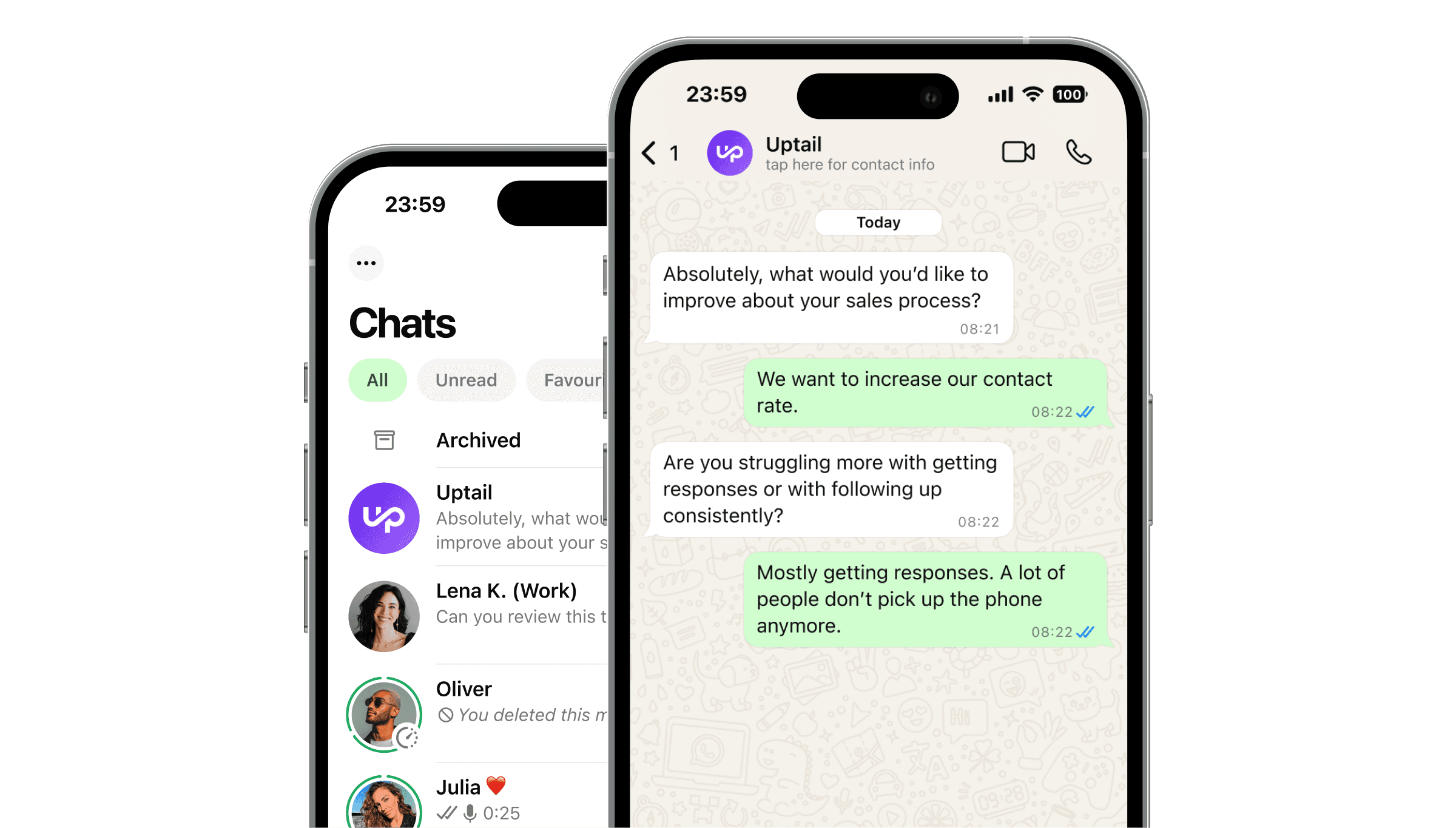
Deploy an AI agent on first-touch: Every inbound lead gets an instant, personalised first message from an AI agent that continues the conversation until the lead is qualified, scheduled, or explicitly disqualified. No lead waits in a queue.
Score in real time and route by threshold: The AI scores each conversation as it develops. Only leads above the hot threshold (typically the top 10–20%) get routed to a human rep, everyone else stays with the AI agent.
Pre-integrate with the CRM before the spike: Every message, score change, and outcome writes back to the CRM in real time. Without this, the sales team loses visibility the moment the AI takes over first response.
Load-test before you launch: Run a rehearsal at 3–5× normal volume before the real spike hits. Measure response time, qualification accuracy, and handoff latency. Fix before launch, not during.
Set guardrails for handoff: Define exactly when the AI pauses and routes to a human, a price objection, a specific competitor mention, a negative sentiment spike. The AI should know when to stop, not just when to start.
3 High-Performing Use Cases for High-Volume Inbound Handling
Product launches and PR spikes
A well-timed launch can 20–50× inbound overnight. AI-first handling absorbs the spike without dropping the response SLA, which is usually the difference between a launch that converts and a launch that just generates traffic.
Paid ad campaigns (including Click-to-WhatsApp)
CTWA ads in particular deliver thousands of leads per day at uneven quality. Real-time scoring filters the noise so paid media spend compounds into booked meetings instead of into a queue.
Seasonal peaks (Black Friday, enrolment windows, back-to-school)
Predictable spikes are the easiest to prepare for and the most expensive to handle badly. A dedicated AI agent for the peak window protects the full year's marketing budget from a bad response-time week.
Mistakes That Turn a Spike Into a Leaky Funnel
Adding reps instead of capacity: Hiring for a 2-week spike is either too slow or too expensive. By the time the new reps are trained, the spike is over and the leads are cold.
Letting first response drift past 5 minutes: Every minute past five cuts connection rate materially. If the AI doesn't own first response, the spike already costs you most of its conversion potential.
Qualifying everyone the same way: A uniform qualification script wastes rep time on cold leads and under-qualifies hot ones. Without real-time scoring, reps default to first-come-first-served — the worst possible routing during a spike.
No post-spike review: Spikes are the best learning events a sales team gets. Not reviewing the transcripts, score distributions, and conversion data afterwards means the next spike starts from the same place as the last one.
High-volume inbound is a solved problem once first response is owned by an AI agent and routing is owned by a real-time scoring model.
The teams that still treat a spike as a staffing crisis are the ones whose best-performing campaigns keep producing their worst conversion weeks.
The teams that have built the system once stop thinking about spikes at all, volume becomes a revenue event, not an operational one.