Carlos Delgado
Pay Per Performance AI: A Guide for Buying AI That Actually Pays for Itself
Every founder has signed the same AI contract at least once. A 12-month seat license, a pilot that never makes it to production, and a renewal conversation that nobody on either side wants to have.
Then the board asks what the AI line item actually returned, and the answer is a slide full of usage metrics. Hours saved, prompts run, tickets touched, anything except revenue.
Most teams assume the fix is to cut AI spend or negotiate harder on seats. It isn't. The fix is a different pricing model, one where the vendor gets paid when the AI delivers a result, and only then.
Quick Answer
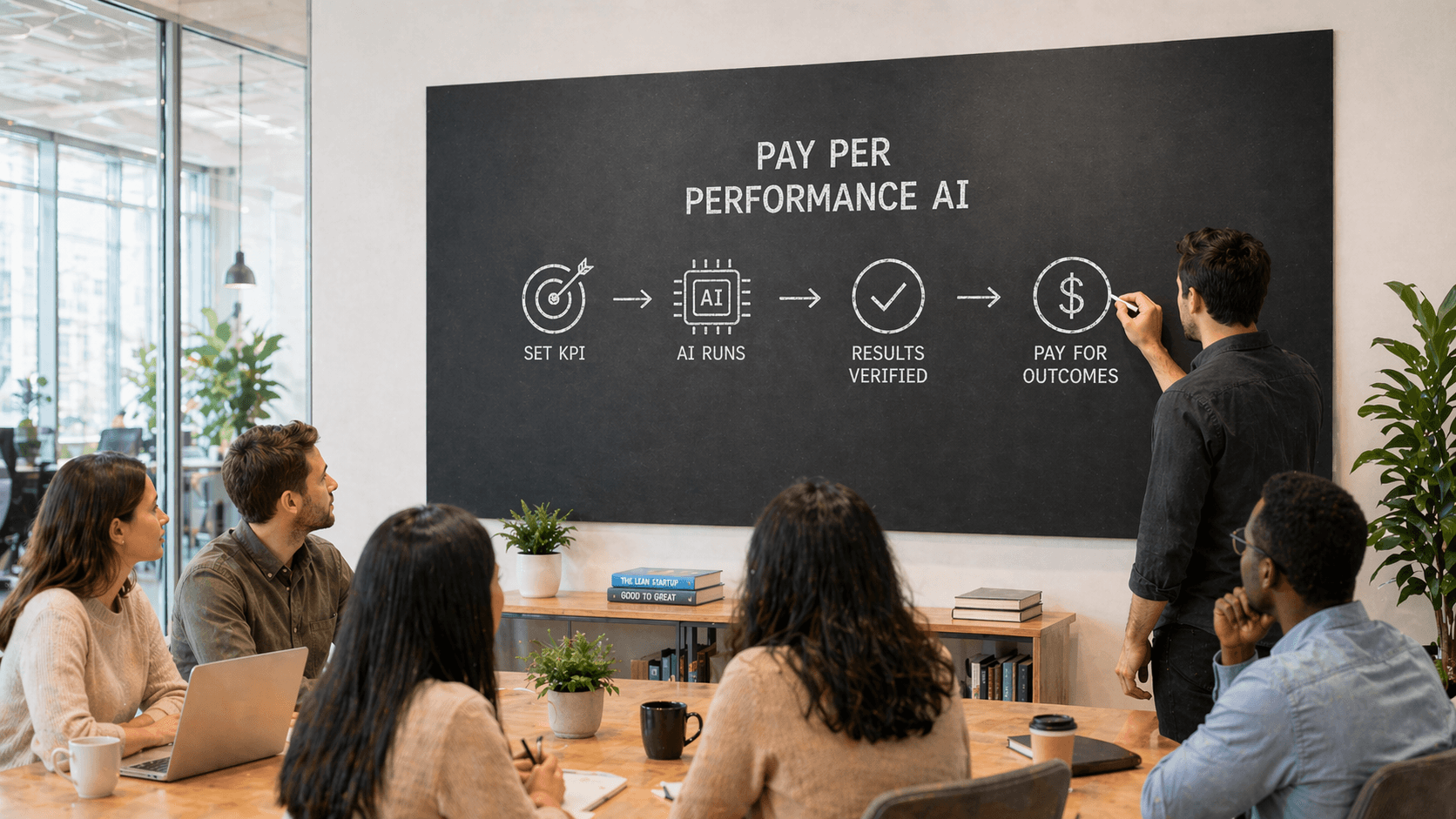
Pay per performance AI is a pricing model where you pay only when AI delivers a measurable business outcome, a meeting booked, a ticket resolved, a dollar recovered, instead of paying for seats, tokens, or usage. It turns AI from a fixed SaaS cost into a variable, outcome-linked one, aligns vendor incentives with customer results, and is becoming the default pricing model for agentic AI in 2026.
How Pay-Per-Performance AI Differs from Seat-Based AI
Both models sell the same thing on paper: an AI product that does work for your team. They diverge the moment you open the invoice.
Seat-Based AI | Pay-Per-Performance AI | |
|---|---|---|
What you pay for | Licenses, tokens, compute | Verified outcomes |
Vendor incentive | Activate users | Produce results |
Risk of non-performance | Buyer absorbs it | Vendor absorbs it |
Cost curve | Fixed, paid upfront | Variable, scales with value |
The real shift is that pay-per-performance decouples AI spend from adoption theater. A founder no longer has to champion a tool internally to justify the contract, the tool justifies itself every month, or it doesn't get paid.
Step-by-Step: Structuring a Pay-Per-Performance AI Contract
Define the outcome unit precisely: A "meeting" is not an outcome, a meeting that held for 15+ minutes and was accepted by an account executive is. Narrow the unit until gaming is impossible.
Benchmark the outcome against your current cost: Know what that same unit costs today via headcount, agency, or existing tool. The per-outcome price should be materially below that baseline.
Lock the verification mechanism: Outcomes should be verified inside your system of record (your CRM, helpdesk, or billing system) not the vendor's dashboard. If the vendor owns the scoreboard, the model is broken.
Set a floor and a cap: A small monthly minimum keeps the vendor engaged. A monthly cap keeps finance from getting a surprise invoice in a great month.
Write the offramp into the first page: Performance pricing only works if you can leave when performance slips. 30-day termination clauses are the market standard, push back hard on anything longer.
Agree on the data rights up front: Workflow logs, transcripts, and model fine-tuning data should be yours to export. Without that, the vendor owns your switching cost.
3 High-Performing Use Cases for Pay-Per-Performance AI
Outbound sales and SDR work
Priced per qualified meeting held, not per seat. The AI prospects, personalizes, and books, and the invoice matches the pipeline it created, the cleanest unit economics most founders have ever seen on a sales line item.
Customer support deflection
Priced per ticket fully resolved without a human handoff. Support goes from a linear cost that scales with user growth to a variable cost that scales with actual complexity, a structural margin unlock for any SaaS business at scale.
Collections and AR recovery
Priced as a percentage of dollars recovered. Finance teams love it because it's self-funding by definition: no recovery, no invoice, and every dollar that comes in has already paid for itself.
Mistakes That Turn Performance Pricing Into Seat Pricing in Disguise
Accepting a vague outcome definition
"Engagements" and "interactions" are seat pricing with extra steps. If the outcome isn't something your CFO would recognize as a business result, the model will quietly revert to usage-based billing.
Letting the vendor own attribution
If the AI's dashboard is the only source of truth, every close call gets counted. Verification has to live in your systems.
Signing a 12-month commit to get a discount
The whole point of performance pricing is that the vendor earns the renewal every month. A long commit eliminates that discipline.
Skipping the post-quarter review
Performance pricing produces the cleanest ROI data a founder will ever see on AI. Not reviewing it quarterly means leaving both pricing leverage and vendor accountability on the table.
Pay-per-performance AI is a solved buying problem once the outcome is defined in the buyer's systems and the vendor accepts real downside when the AI underperforms.
The founders who still buy AI by the seat are the ones whose most expensive line items keep producing their quietest board updates.
The ones who have restructured once stop thinking about AI as a cost at all, it becomes a revenue event, not an operational one. That's the model Uptail is built on: outcomes verified in your systems, billed only when they land.