Carlos Delgado
The question Salesforce admins ask after seeing WhatsApp conversion numbers is always the same: can we connect this to Salesforce?
The answer is yes, but the path matters more than people expect.
There are three distinct integration routes, each with different setup complexity, sync depth, and gaps. Choosing the wrong one does not just create technical debt. It creates lead records without conversation history, opt-in fields that never get populated, and sales reps working blind.
Here is what each path actually delivers in 2026.
Quick Answer
Salesforce connects to WhatsApp via three routes: native Digital Engagement through Service Cloud, AppExchange connectors, or third-party WhatsApp platforms with bi-directional Salesforce sync. Native offers the deepest CRM integration but has no visual bot builder and limited broadcast capability. Third-party AI platforms like Uptail own the conversation logic and sync key fields back to Salesforce. The five fields to always map: contact record, conversation transcript, lead source, opportunity stage, and opt-in status.
Three Integration Paths: What Each One Actually Syncs
Integration Path | Setup Complexity | Contacts Sync | Conversation Logs | Lead/Opp Updates | Bot/Qualification Logic | Broadcast Capability | Plan Required |
|---|---|---|---|---|---|---|---|
Salesforce Digital Engagement (native) | High | Yes | Yes | Partial | No native builder | Limited | Service Cloud Enterprise+ |
AppExchange WhatsApp connectors | Medium | Yes | Partial (varies by app) | Varies | Some offer basic flows | Some | Depends on app |
Third-party AI platforms (bi-directional sync) | Medium | Yes | Yes, full transcript | Yes, triggered by message events | Full qualification logic | Yes, with template management | API access required |
The native Salesforce route (Digital Engagement, part of Service Cloud) is the most integrated with CRM objects but requires significant setup, an Enterprise license or above, and a Facebook Business account connected to a verified WhatsApp Business number.
It logs conversations against contact records and allows agents to send and receive messages inside Salesforce. It does not provide a visual bot builder, cannot run qualification flows autonomously, and has limited outbound broadcast capability.
AppExchange connectors vary widely in quality. Some sync full transcripts, some only log message counts. Evaluate each against the five fields that matter (covered below) before committing.
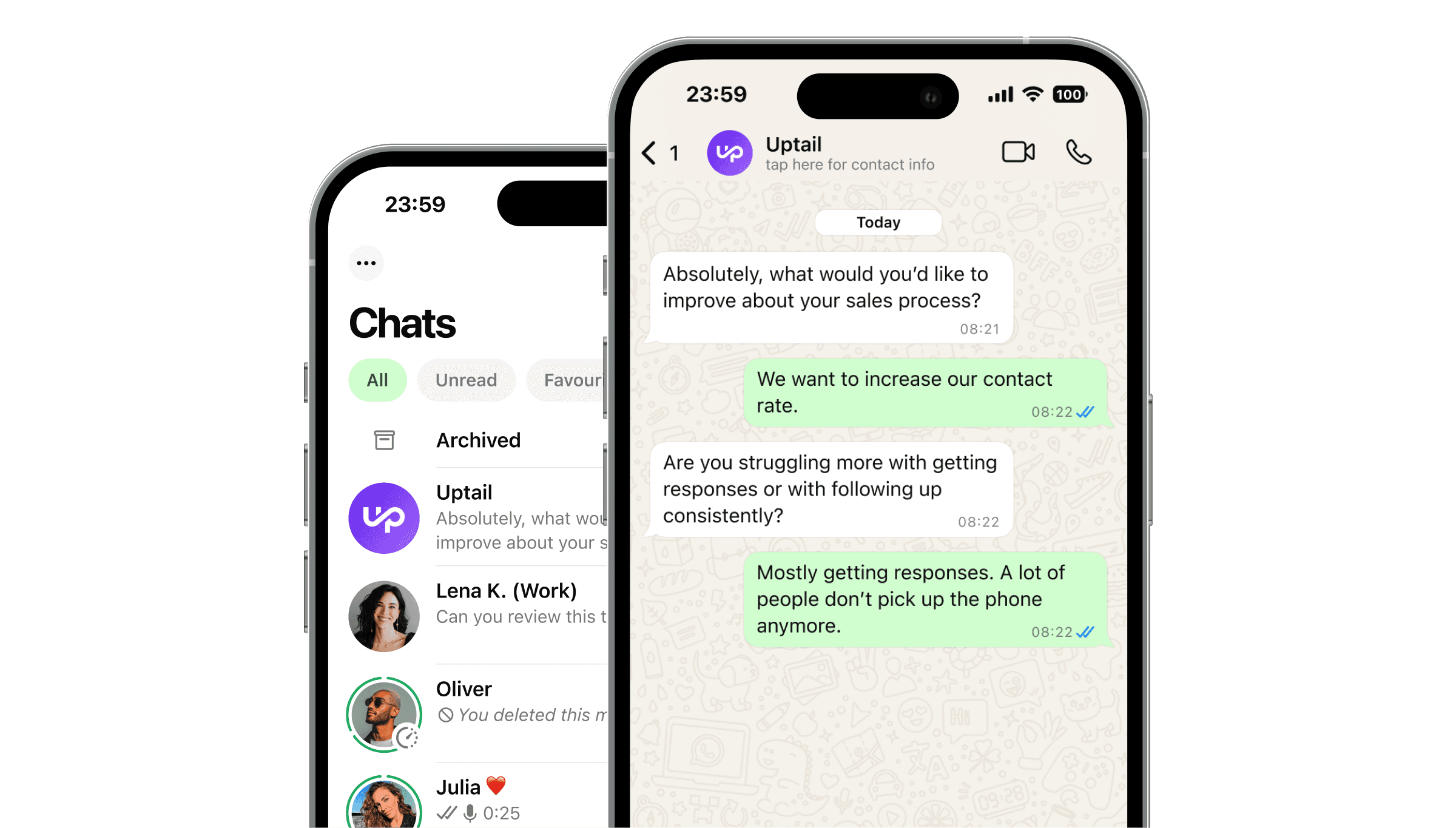
Third-party AI platforms, including Uptail, operate differently. They own the conversation layer, handle qualification, objection handling, and booking, and push the resulting data back to Salesforce via API.
The CRM sees the outcome: a qualified contact, an updated opportunity stage, a logged transcript, an opt-in record. The AI platform handles everything in between.
Step-by-Step: Connecting WhatsApp to Salesforce Without Creating Data Gaps
Choose and verify your WhatsApp Business number: The number must be registered as a WhatsApp Business API number through a Business Solution Provider. If that number is currently connected to the WhatsApp Business app (the mobile application), it must be migrated first. Using a number still linked to the app while setting up API access causes message delivery failures and data loss.
Decide which integration path fits your Sales Cloud setup: If qualification, conversation logic, and booking automation are required, a third-party AI platform with Salesforce sync is the right layer. If the requirement is purely inbound message management inside Service Cloud, native Digital Engagement covers it.
Map your Salesforce objects to WhatsApp data before a single message is sent: Define where each data type lives before go-live. Contacts, transcripts, lead source, opportunity stage, and opt-in status each need a home. Retrofitting this after deployment means days of data cleanup.
Configure bi-directional sync, not just inbound logging: Most teams set up Salesforce to receive data from WhatsApp. Fewer configure Salesforce events to trigger WhatsApp actions. Opportunity stage changes, lead assignment events, and form submissions can all trigger WhatsApp outreach automatically when the sync runs both directions.
Handle the 24-hour service window in your flow design: WhatsApp allows free-form messages only within 24 hours of the customer's last inbound message. Outside that window, only approved Message Templates can be sent. Salesforce's native Digital Engagement does not manage this automatically. Your flow logic must account for window status before triggering outbound messages or you will encounter delivery failures.
Test opt-in field population end-to-end: Opt-in records must be tied to individual contact records, not just assumed from a form submission. Run a test lead through the full flow and confirm the opt-in field on the Contact object is populated with consent language, timestamp, and channel.
Set up conversation log retrieval: Confirm that full transcripts are retrievable against the Contact or Lead record within your defined retention period. A log that exists in the WhatsApp platform but is not linked to the Salesforce record does not count for audit purposes.
3 Use Cases Where Salesforce + WhatsApp Integration Pays Off
Lead Routing from WhatsApp to Sales Cloud
A B2C company running click-to-WhatsApp ads on Meta has leads hitting the WhatsApp number at volume. Without integration, those conversations stay outside Salesforce entirely. With a connected AI platform, each new conversation creates or updates a Lead record, appends the conversation transcript, populates lead source as "CTWA" (click-to-WhatsApp-ad), and routes the lead to the correct sales queue based on qualification responses. Sales reps see a warm, qualified lead with full context.
Opportunity Stage Updates Triggered by Message Events
A real estate firm uses WhatsApp to handle inbound property enquiries. When a prospect books a viewing through the AI agent, the connected Salesforce sync moves the linked Opportunity from "Enquiry" to "Viewing Booked" automatically. No manual update, no lag. The sales manager's pipeline view reflects reality in real time.
Conversation Logs on Contact Records for Renewal Teams
An insurance firm uses WhatsApp for renewal outreach. Every conversation, including the customer's stated objections and the agent's responses, is logged as an Activity against the Contact record. When the renewal manager calls the customer, they see the full WhatsApp exchange. No repeated questions, no broken context.
Mistakes That Quietly Kill Salesforce WhatsApp Integrations
Using a WhatsApp Business App number for API integration: The number migration process takes time and causes a service interruption. Teams that skip the check and try to run both simultaneously lose messages. Verify number type before any integration work starts.
Ignoring the 24-hour service window in flow design: Salesforce automation that triggers outbound WhatsApp messages does not automatically check window status. A flow that fires after an Opportunity stage change will fail if the customer's last message was more than 24 hours ago. Template management must be built into the flow.
No opt-in field on the Contact object: Teams often assume opt-in is captured elsewhere. In a GDPR audit or a customer complaint, "we assumed they opted in" is not a defence. The opt-in record must live on the Contact, not in a spreadsheet or a third-party platform that legal cannot access.
Mapping only outbound fields: Teams configure the sync to push Salesforce data into WhatsApp (contact name, product interest) but do not pull WhatsApp data back into Salesforce (transcript, qualification score, booking status). The CRM stays incomplete and reps operate without context.
Treating integration as a one-time setup: WhatsApp template statuses, API rate limits, and Salesforce field changes all require ongoing maintenance. Integration that works at launch and breaks three months later, without anyone noticing, is worse than no integration at all.
The gap that kills most Salesforce WhatsApp deployments is not technical. It is that teams treat the integration as a logging exercise rather than a data architecture decision. The firms that get it right define the five fields, test the full loop before launch, and build the 24-hour window into every outbound flow from day one.
When those things are in place, the CRM actually reflects what is happening in the pipeline.