Carlos Delgado
What an AI Sales Agent Should and Shouldn't Handle in Your Admissions Funnel

Quick Answer
An AI sales agent should own first contact, qualification, programme FAQs, re-engagement, and call booking. It should not handle complex financial conversations, emotional or high-stakes moments, formal application support, or exceptions that fall outside standard criteria. In a well-configured funnel, the agent resolves roughly 70–80% of inbound conversations, and makes the remaining 20–30% that go to a human significantly more productive.
The biggest source of disappointment with admissions AI agents isn't the technology. It's misaligned expectations about what the agent should be doing. Institutions that deploy AI expecting it to replace the entire admissions function end up frustrated. Institutions that deploy it to own the top of the funnel, and only the top, see strong results. The line matters.
What the AI Sales Agent Should Handle
First contact and instant response
The agent owns the first 60 seconds of every inbound inquiry, from a web form, a WhatsApp button, a click-to-WhatsApp ad, an open day registration, or a social media campaign. Every inquiry receives an immediate, personalised response from the agent.
This is the highest-leverage thing an AI agent does in admissions. Speed to first contact is the single biggest variable in whether a lead converts. An agent responding in under 60 seconds consistently outperforms a human responding in two hours, even when that human is more experienced.
Qualification
The agent captures the information advisors need before a call: programme interest, timeline, current situation, and key concerns. Done well through a natural conversation, this takes 3–5 messages and produces a complete pre-call brief for the advisor.
This replaces the discovery phase of the advisor call, the part where advisors are asking "tell me about yourself" while trying to understand who they're talking to. That phase is a poor use of advisor time and a friction point for prospective students who have already told their story once.
Programme FAQs and information
The agent answers the 80% of questions that get asked repeatedly: fees, duration, entry requirements, intake dates, funding options, the difference between similar programmes. These questions have accurate, consistent answers that an AI agent delivers faster and more reliably than a busy advisor.
Re-engagement of cold leads
Prospective students who inquire and then go quiet are a major source of recoverable revenue. The agent runs structured re-engagement sequences: a check-in after three days, a prompt before an application deadline, a personalised message when a new intake opens. These sequences are too time-consuming for advisors to run manually at any meaningful scale.
Call booking
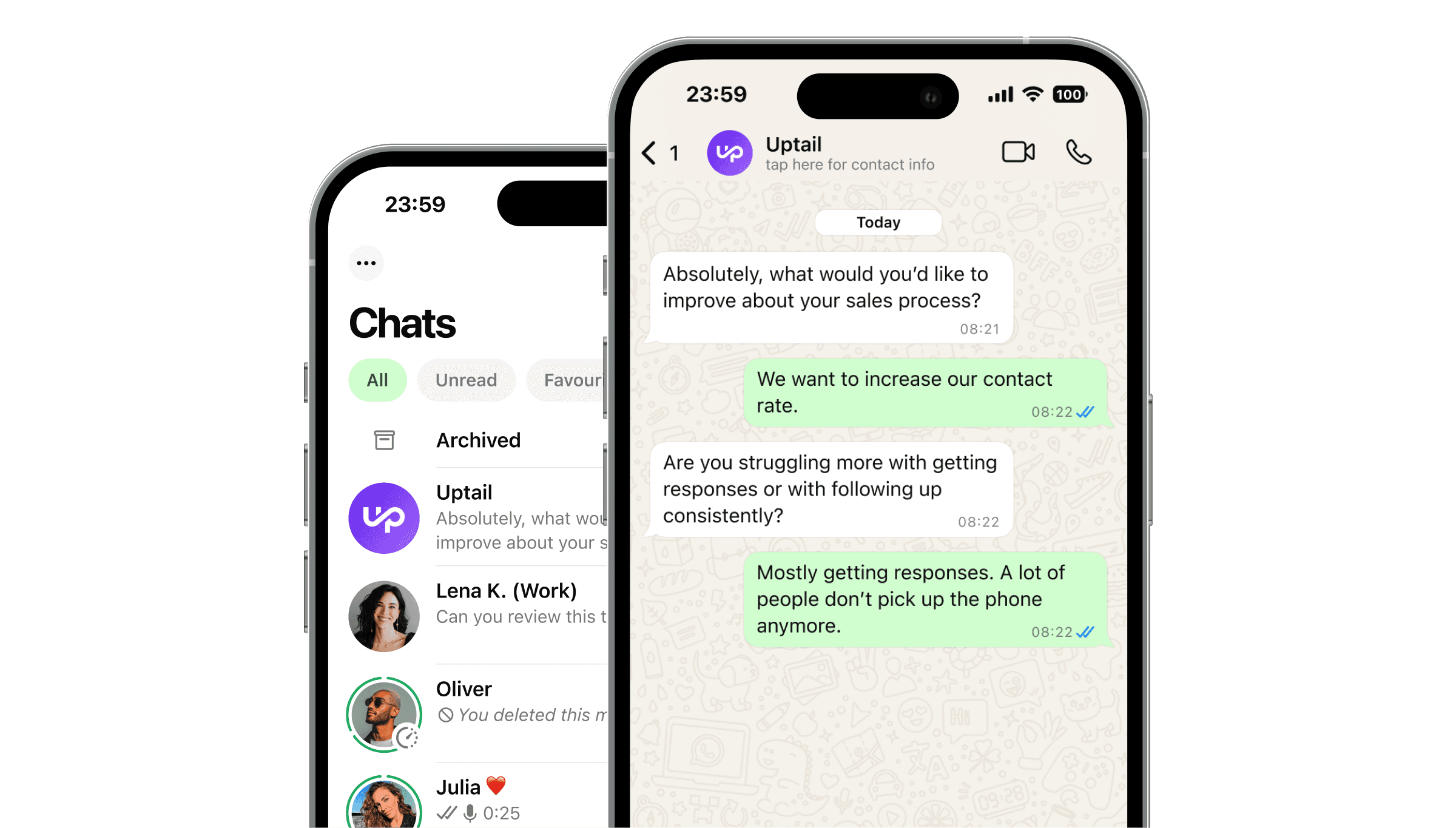
Once a lead is qualified and ready to speak to someone, the agent books the call, directly, inside the conversation, with the right advisor, at the right time, with a pre-call brief already in the CRM.
What the AI Sales Agent Shouldn't Handle
Complex financial conversations
Fee disputes, payment plan negotiations, financial hardship discussions, and employer sponsorship arrangements need a human. Not because the agent can't recite fee information, but because these conversations often involve institutional flexibility, reassurance, and nuance that can't be scripted. A prospective student who is genuinely worried about whether they can afford the programme needs a real person, not a message.
Emotional or high-stakes moments
A prospective student who has just been rejected from a programme they wanted, is considering withdrawing an application due to personal circumstances, or is asking whether your institution is truly the right fit — these conversations require human empathy and judgment. The agent should recognise these signals and escalate immediately.
Formal application support
Helping an applicant craft a personal statement, reviewing a portfolio submission, or advising on how to present a non-standard background is advisor work. The agent can confirm deadlines and link to submission portals. It should not be guiding the application content itself.
Exceptions and special circumstances
Anything outside your standard criteria, a mature student asking about prior learning recognition, an international applicant with non-standard qualifications, a request for deferred entry outside the normal window, needs a human decision. The agent should identify these situations and escalate immediately rather than attempt an answer.
The Practical Split
Task | AI Agent | Human Advisor |
|---|---|---|
First contact (under 60 seconds) | ✓ | |
Lead qualification | ✓ | |
Programme FAQs | ✓ | |
Cold lead re-engagement | ✓ | |
Call booking | ✓ | |
Complex financial conversations | ✓ | |
Emotional or high-stakes moments | ✓ | |
Application content support | ✓ | |
Non-standard entry decisions | ✓ | |
Pre-call brief delivery to advisor | ✓ |
In a well-configured admissions funnel, the AI agent handles roughly 70–80% of all inbound conversations to resolution (based on Uptail platform data across active education admissions deployments), answering the question, qualifying the lead, booking the call, or re-engaging the cold prospect.
The remaining 20–30% are conversations that genuinely require a human, and the agent's job is to get those to the right person with full context as quickly as possible.
Frequently Asked Questions
How do we configure the agent to recognise when to escalate?
Define escalation triggers explicitly during setup. The most reliable ones are: specific keywords (financial hardship, visa, rejection, withdraw), expressions of frustration, and any direct request to speak with a person. Review conversation logs in the first few weeks and add triggers based on what you see.
What if the agent gives incorrect information before it can be corrected?
This is a knowledge base problem, not a fundamental AI limitation. Keep the knowledge base updated, and build in a process for reviewing agent responses during the first month of operation. Set conservative confidence thresholds — it's better for the agent to escalate than to guess.
Should the agent handle post-offer communications?
For straightforward communications, confirming offer details, providing next steps, yes. For anything involving negotiation, appeals, or complex conditions, no. Apply the same principle: if the answer requires human judgment or institutional flexibility, it should go to a human.
What's the right tone for escalation messages?
Warm and practical. Don't make the prospective student feel like they've reached a limit. Frame the handoff as getting them to the right person for their specific question, not as the agent being unable to help.
How do we make sure advisors actually use the pre-call briefs?
Make the brief visible in the tool advisors use to manage their call queue, their CRM or calendar app. If it requires a separate login or extra click to find, it won't be used consistently. Visibility drives adoption.