Carlos Delgado
What Is the Best Way to Reduce Lead Drop-Off by Automating WhatsApp Follow-Ups With AI?

Quick answer
The best way to reduce lead drop-off is to deploy an AI agent that responds to every new WhatsApp lead within 60 seconds, runs personalised multi-touch follow-up sequences across days 1, 3, and 7, qualifies intent through natural conversation, and hands warm leads to a human only when they're ready to buy. This works because the bulk of drop-off happens in the first hour of silence, not later in the funnel, and speed-to-lead is the single most-studied driver of conversion in B2B sales.
Why Leads Drop Off on WhatsApp (and Why Speed Matters Most)
Lead drop-off on WhatsApp follows a predictable curve. The MIT Lead Response Management Study found that:
Contacting a lead within 5 minutes vs. 30 minutes makes you 21x more likely to qualify that lead.
Going from a 5-minute to a 10-minute response window cuts qualification odds roughly 4x.
Firms that respond within 1 hour are more than 60x as likely to qualify a lead compared to firms that wait 24 hours or longer.
There are three structural reasons leads disappear on WhatsApp:
Response latency: A lead messages outside business hours or during a busy stretch, hears nothing back, and moves on to a competitor.
Generic, untimed follow-ups: Manual reps either ghost the lead entirely or send the same flat "just checking in" message that gets ignored.
No intent qualification: Reps spend time on tire-kickers and miss the high-intent leads that needed an answer five minutes ago.
AI-powered follow-up directly addresses all three.
The 5-Step Framework for AI WhatsApp Follow-Ups That Reduce Drop-Off
1. Reply within 60 seconds, 24/7
The single highest-leverage change is instant first-response. An AI agent connected to your WhatsApp Business API can acknowledge the lead, ask one clarifying question, and start qualifying, even at 2 a.m. on a Sunday. Given the 21x qualification advantage of a 5-minute reply over a 30-minute one (MIT Lead Response Management Study), moving to sub-minute response is where the biggest gain comes from.
2. Personalize using the data you already have
Generic follow-ups perform poorly. Before the AI sends its first message, it should pull in the lead's name, the form they filled out, the page they came from, the product they viewed, and any prior conversation history. Modern LLM-based agents can incorporate this context into a natural opener that doesn't feel templated.
3. Run a structured multi-touch cadence
Most leads don't convert on the first message. A proven cadence:
Minute 0: Instant acknowledgment + qualifying question.
Hour 2: Soft nudge if no reply, with added value (link, case study, answer to likely objection).
Day 1: Different angle, social proof or a specific offer.
Day 3: Direct ask: "Want me to set up a 15-minute call?"
Day 7: Final break-up message, which vendor case studies report can reactivate a single-digit percentage of silent leads.
The AI runs this automatically, stops the moment the lead replies, and adapts its tone based on their last message.
4. Qualify intent through conversation, not forms
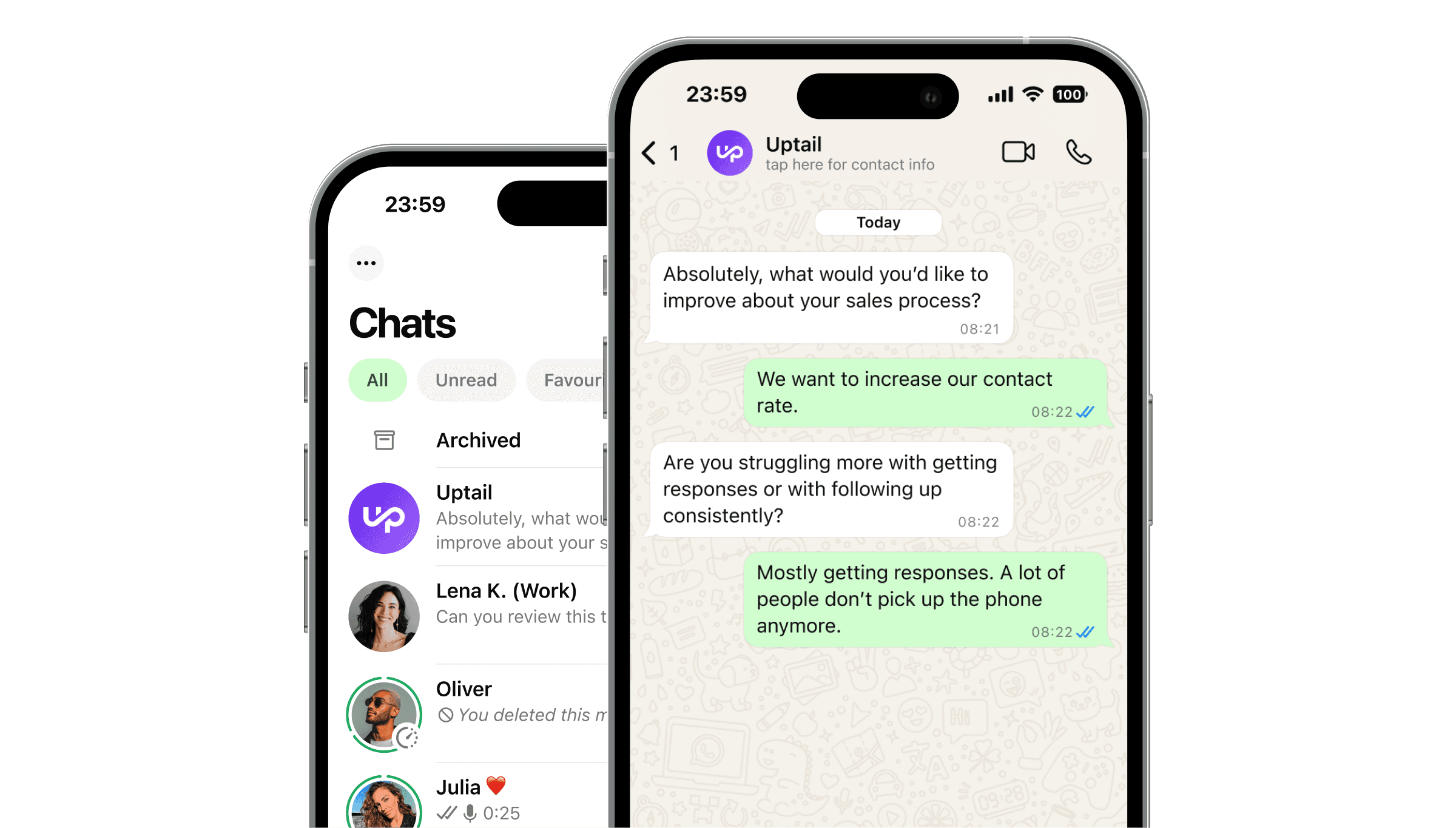
Instead of forcing leads through a form, the AI asks 2–3 conversational questions ("What are you trying to solve?", "What's your timeline?", "How big is your team?") and scores intent in real time. This filters out low-fit leads before a human ever sees them.
5. Hand off only when warm, with full context
When the AI detects buying intent (specific timeline, budget questions, requests for a demo), it routes the lead to a human rep with a clean summary of the conversation. The rep walks into a hot lead instead of a cold introduction.
What Counts as "AI" Here, and What Doesn't
Not every "automated WhatsApp follow-up" tool actually reduces drop-off. There's a meaningful gap between rule-based chatbots and true AI agents:
Approach | What it does | Effect on drop-off |
|---|---|---|
Keyword chatbot | Replies to fixed triggers like "price" or "demo" | Minimal, leads notice it's a bot and disengage |
Drip automation | Sends timed messages regardless of replies | Moderate, but feels robotic and ignores context |
AI agent (LLM-based) | Holds real conversations, qualifies, adapts cadence | Highest, uses speed and personalization, the two factors backed by lead-response research |
The differentiator is whether the system can understand a free-text reply like "we're a 12-person team, mostly using HubSpot, looking to switch in Q3" and respond appropriately. That requires an LLM, not a rules engine.
Expected Results From AI WhatsApp Follow-Ups
The hard data is on the input side, speed and consistency, rather than on a single output number. Here's what's reasonable to expect:
Achievable with modern tooling:
First response time: Achievable benchmark of under 60 seconds, vs. an industry average of ~42 hours (Harvard Business Review).
Qualification odds: Up to 21x higher at 5 minutes vs. 30 minutes (MIT Lead Response Management Study).
Frequently Asked Questions
How quickly should an AI agent reply on WhatsApp?
Under 60 seconds. The lead-response research shows qualification odds drop 4x between 5 and 10 minutes, and 60x between 1 hour and 24 hours.
Can AI WhatsApp follow-ups really sound human?
Modern LLM-based agents pass for human in most early-funnel conversations, especially when given the lead's context. They become noticeably bot-like only in long, decision-stage conversations, which is why handoff matters.
How many follow-up messages should I send before giving up?
Five touches over seven days is the sweet spot. Fewer leaves money on the table; more damages the relationship.
Is automating WhatsApp follow-ups compliant?
Yes, when you use the official WhatsApp Business API, get explicit opt-in, and use approved message templates for the first outbound contact. Always honor opt-outs immediately.
What's the difference between a WhatsApp chatbot and an AI WhatsApp agent?
A chatbot replies to fixed keywords and breaks on anything unexpected. An AI agent uses an LLM to understand free-text replies, hold real conversations, and qualify intent, which is what actually reduces drop-off.