Carlos Delgado

How WhatsApp AI Agents Personalize Conversations at Scale (Without a Human in the Loop)
Most businesses treat WhatsApp as a broadcast channel. They send the same message to thousands of contacts, get decent open rates, and call it personalisation.
That is not personalisation. That is mass messaging with a name tag.
Real WhatsApp AI personalisation means every conversation adapts in real time, based on who the customer is, what they have done before, where they are in the journey, and what they are asking right now. It is the difference between a message that feels like it was written for you and one that clearly was not.
This guide explains what WhatsApp AI personalisation actually means, how it works technically, and what businesses in 2026 are doing with it.
Quick Answer
WhatsApp AI personalisation is the practice of using AI agents connected to CRM and customer data to deliver tailored conversations on WhatsApp — adapting tone, content, offers, and follow-up timing based on each individual's profile, behaviour, and intent. Done well, it increases conversion rates, reduces churn, and makes customers feel understood rather than marketed at.
What Is WhatsApp AI Agent Personalisation?
WhatsApp AI agent personalisation is a conversation approach where an AI agent dynamically adjusts what it says, how it says it, and what action it recommends, based on data it has access to about the individual customer.
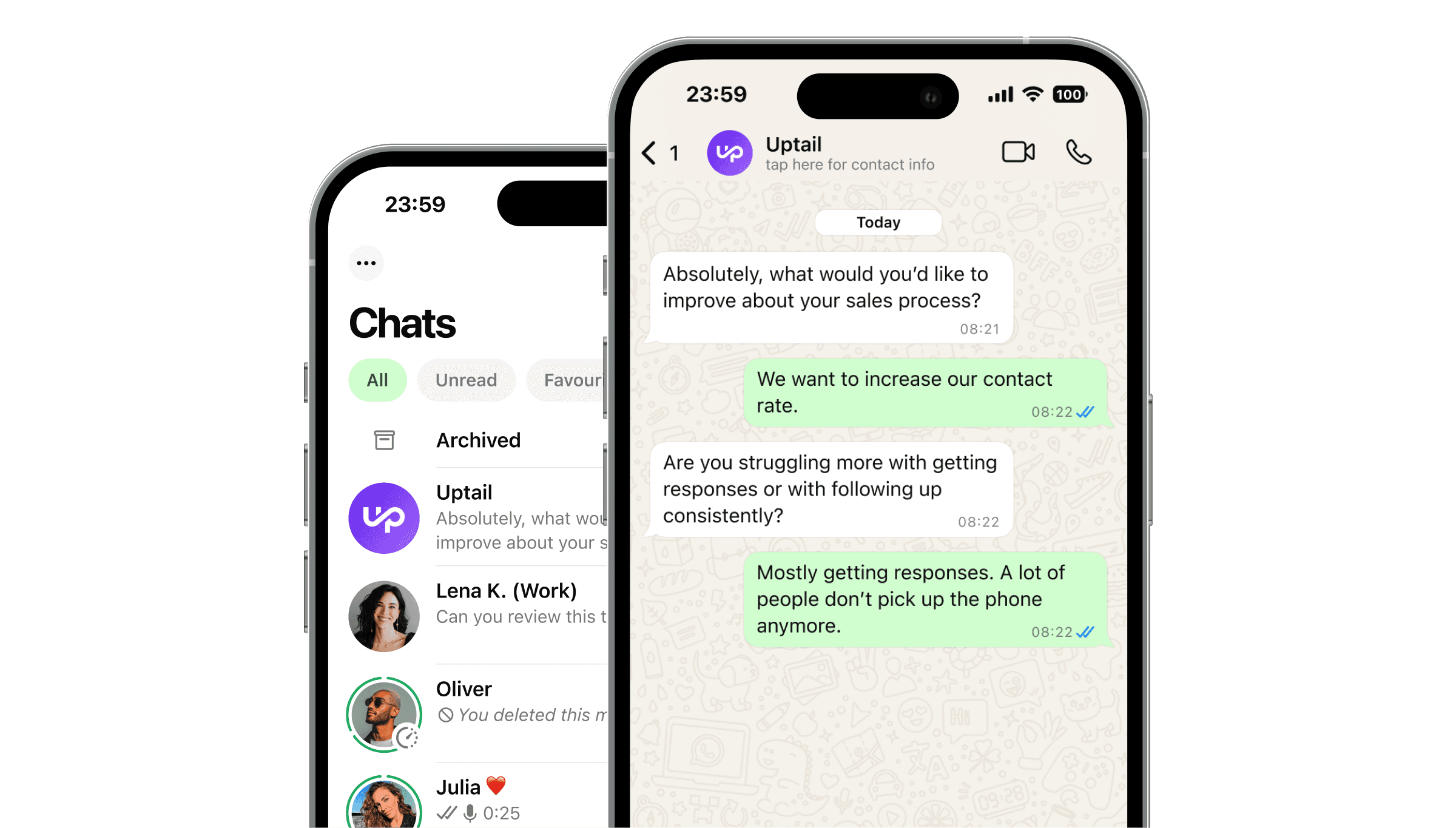
This is distinct from personalisation in email or SMS. On those channels, personalisation is mostly about inserting a name or referencing a past purchase. On WhatsApp, AI agents can hold a two-way conversation that branches in real time based on what the customer says, what they have done previously, and how they are responding now.
The result is a conversation that feels human, not because a human is present, but because the AI has context.
Why Personalisation on WhatsApp Outperforms Other Channels
WhatsApp is already the highest-engagement channel available to most businesses. Messages have open rates above 90%, compared to roughly 20% for email. But what makes WhatsApp specifically powerful for personalisation is the conversational format.
Email personalisation is one-directional: you craft a message, send it, and wait. WhatsApp personalisation is dynamic: the AI agent receives a reply, interprets intent, and responds accordingly, in a loop that can qualify, convert, or support a customer without a human ever stepping in.
The commercial impact of getting this right is significant:
Upselling via personalised automated messages on WhatsApp boosts conversion rates by up to 120%, according to 2026 industry benchmarks
71% of consumers expect companies to deliver personalised interactions, and 76% feel frustrated when they don't, according to McKinsey's Next in Personalization report
Companies that respond to leads within 5 minutes are 100 times more likely to make contact than those who wait 30 minutes.
How WhatsApp AI Agents Personalise Conversations
Personalisation does not happen by accident. It is built from three layers working together.
1. Customer Data and CRM Integration
The AI agent knows who it is talking to because it is connected to your CRM or customer database. Before it sends a single message, it can pull:
The customer's name, company, and contact history
Their previous bookings or enquiries
Where they are in the sales funnel
Which campaign or ad triggered the conversation
Their stated preferences from previous interactions
Without CRM integration, personalisation is superficial. With it, the AI agent can open a conversation referencing exactly what the customer has done and tailor every subsequent message accordingly.
2. Conversational Context
As the conversation unfolds, the AI agent builds a real-time picture of the customer's intent. Their answers to qualifying questions, the topics they raise, the objections they voice, all of this shapes how the agent responds next.
A customer who says "I need this urgently" gets a different response to one who says "I'm still comparing options." A prospect who mentions a specific competitor gets a different framing than one who has never heard of alternatives. The agent adapts without needing a human to make that call.
3. Behavioural Triggers
Personalisation also extends to when and why a conversation starts. AI agents can be configured to initiate personalised outreach based on customer behaviour:
A customer abandons the conversaation: the agent sends a contextual follow-up
A lead goes cold for 5 days: the agent sends a re-engagement message calibrated to where they dropped off
A new product launches/promotion that matches a customer's stated interests: the agent notifies only the relevant segment
Each of these is a personalised message at scale, sent automatically, without a human writing individual messages for each customer.
Personalisation Use Cases by Business Type
B2B Sales
Lead qualification conversations that adapt based on the prospect's company size, industry, and role. Follow-up sequences timed based on engagement signals. Demo preparation messages that reference the prospect's specific use case. Renewal conversations that acknowledge the customer's usage history.
Healthcare
Appointment reminders that include the specific doctor, location, and preparation instructions for that patient's visit. Post-appointment follow-ups tailored to the type of consultation. Medication reminders calibrated to the individual's treatment plan.
Education
Admissions follow-ups that reference the specific programme a prospective student enquired about. Enrolment reminders timed to each student's application deadline. Onboarding messages for new students that reference their course, campus, and intake date. Mid-course nudges for online learners tailored to where they are in the curriculum and how long since their last session.
The CRM Connection: Why It Is Non-Negotiable
Every personalisation capability described above depends on one thing: the AI agent having access to accurate, up-to-date customer data.
That means CRM integration is not optional, it is the backbone of any serious WhatsApp personalisation strategy.
When an AI agent is natively connected to your CRM, two things happen simultaneously:
Incoming data enriches the conversation: the agent knows who it is talking to before the first message is sent
Outgoing data enriches the CRM: every answer a customer gives, every signal they show, every action they take is written back to the CRM record in real time
This creates a virtuous loop: the more conversations happen, the more customer data is captured, and the more personalised future conversations become.
Platforms with native CRM connectors (to HubSpot, Salesforce, Zoho, Dynamics, and others) deliver this loop automatically. Platforms that rely on Zapier or webhooks introduce lag and data loss that degrades personalisation quality over time.
What Good Personalisation Looks Like vs. What It Does Not
What it does not look like:
"Hi [First Name], we have a great offer for you!"
Sending the same broadcast to your entire contact list with one field swapped out
A chatbot that asks for information the customer already gave you two months ago
What it does look like:
"Hi Sofia, you looked at the Pro plan last week. I wanted to follow up and check if you had any questions about the onboarding process."
A follow-up that references the specific objection a customer raised in the previous conversation
An AI agent that already knows the customer's company size, their CRM, and their timeline, and opens a conversation as if a well-briefed sales rep is on the other end
The gap between these two experiences is the gap between a tool that sends messages and a tool that has genuine context.
Getting Personalisation Right: Three Things to Avoid
Over-automation without a human fallback. Personalisation should make the AI feel human, but customers must always be able to reach a real person when it matters.
Using data without disclosing it. Transparency about what the AI knows and how it is using it builds trust rather than eroding it.
Personalising tone but not substance. Calling someone by their name while sending them irrelevant content is worse than not personalising at all. Substance, the actual content of what the AI says, must reflect the customer's real situation, not just their demographic.
Frequently Asked Questions
What is WhatsApp AI personalisation?
WhatsApp AI personalisation is the use of AI agents connected to CRM and customer data to deliver conversations that adapt in real time to each individual — based on their history, behaviour, stated preferences, and current intent.
Does WhatsApp AI personalisation require CRM integration?
For meaningful personalisation, yes. CRM integration gives the AI agent access to customer history, segment data, and funnel stage before the first message is sent. Without it, personalisation is limited to the data captured within the current conversation only.
Can WhatsApp AI personalisation work at scale?
Yes. This is precisely where AI agents outperform human teams. A human agent can manage 20–30 personalised conversations per day. An AI agent handles thousands simultaneously, with no degradation in personalisation quality.
Is personalised WhatsApp messaging compliant?
Yes, when built on the WhatsApp Business API with proper opt-in consent. Customers must agree to receive messages before personalised outreach can begin. Most businesses collect this consent through a website form, ad click-to-WhatsApp, or in-store sign-up.