Carlos Delgado
Most businesses spend the majority of their marketing budget trying to acquire new customers. But the easiest person to sell to is someone who has already bought from you, and stopped.
A win-back campaign targets lapsed customers: people who were once engaged but have gone quiet. On WhatsApp, these campaigns consistently outperform every other re-engagement channel because the message lands where the customer already spends their time, and it arrives as a personal conversation rather than a newsletter they will never open.
This guide covers how WhatsApp win-back campaigns work, what makes them effective, and seven real examples you can adapt for your own business.
Quick Answer
A WhatsApp customer win-back campaign is an automated message sequence sent to lapsed customers on WhatsApp, designed to re-engage them with a personalised offer, relevant content, or a direct conversation. WhatsApp win-back messages achieve 20–35% re-engagement rates compared to 8–12% for equivalent email campaigns, driven by WhatsApp's near-universal open rates and conversational format.
What Is a WhatsApp Win-Back Campaign?
A WhatsApp win-back campaign is a targeted automated outreach sequence sent to customers who have not purchased, engaged, or responded within a defined window, typically 60, 90, or 180 days.
Unlike a broadcast promotion sent to your entire contact list, a win-back campaign is triggered by inactivity. The customer's silence is the signal. The campaign's job is to find out why they went quiet and give them a compelling reason to come back.
On WhatsApp, win-back campaigns benefit from one structural advantage no other channel offers: the message arrives in the same inbox the customer uses to talk to their friends and family.
Why WhatsApp Outperforms Email for Win-Back
Email win-back campaigns are the industry default, but they face compounding disadvantages for lapsed customers specifically:
Lapsed customers are more likely to have unsubscribed, marked emails as spam, or changed their email address
Deliverability drops as engagement wanes, meaning win-back emails often never reach the inbox
Even when delivered, email open rates for lapsed segments average 8–12%
WhatsApp sidesteps all three problems. The customer's phone number is stable, deliverability is not affected by engagement history, and messages arrive as notifications rather than inbox items competing with hundreds of other brands.
The result is a channel that is structurally better suited to reaching people who have already tuned you out.
Bain & Company research shows that increasing customer retention by just 5% can increase profits by 25–95%. Win-back campaigns are one of the highest-leverage retention levers available, and WhatsApp is the highest-leverage channel to run them on.
How to Segment Lapsed Customers Before You Send
Not all lapsed customers are the same, and sending the same message to everyone who has not bought in 90 days will underperform a segmented approach.
The most effective segmentation model uses three tiers based on recency:
Tier 1: 60–90 days inactive
These customers are still warm. They remember your brand and likely left for a specific reason, price, timing, or finding an alternative. A single personalised message with a modest incentive is often enough to bring them back.
Tier 2: 90–180 days inactive
The relationship has cooled. These customers need a stronger reason to re-engage, a more meaningful offer, social proof, or something genuinely new to share.
Tier 3: 180+ days inactive
These customers have almost certainly moved on. The campaign goal shifts from re-engagement to requalification: find out if they are still a potential customer at all, and if not, remove them from your active list.
Running separate flows for each tier with different messaging and offer intensity consistently outperforms a one-size-fits-all approach.
3 WhatsApp Win-Back Campaign Examples
1. The Direct Check-In (B2B and Services)
Who it is for: B2B lapsed clients or service customers who stopped engaging
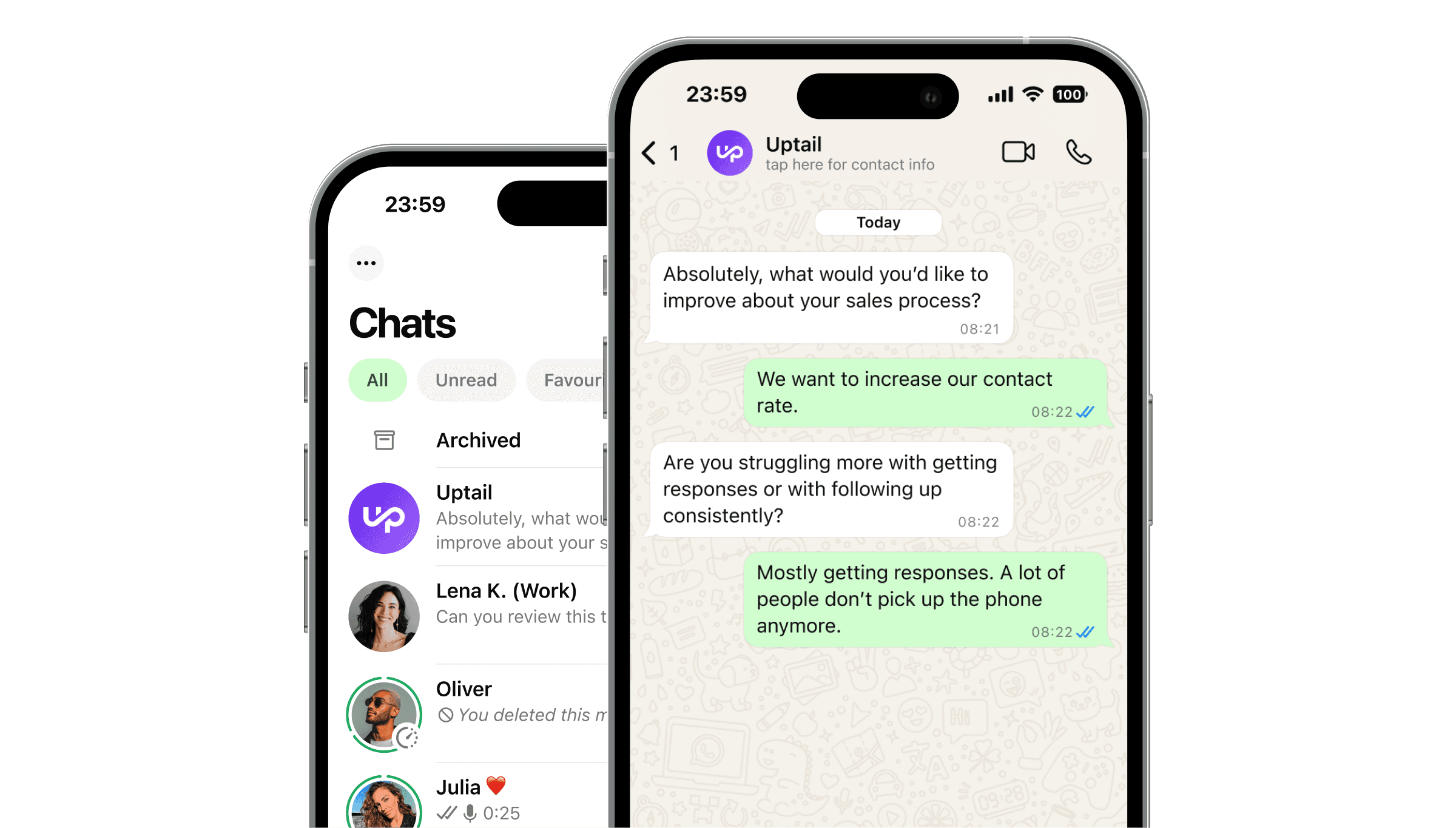
How it works: Rather than sending a promotional message, the AI agent sends a short, direct message asking if anything changed, treating the customer as a person rather than a target.
Example message:
"Hi [Name] — we haven't heard from you in a while and wanted to check in. Has anything changed on your end, or is there something we could have done better? Happy to chat if useful."
Why it works: B2B customers respond poorly to promotional win-back messages but will often reply to a genuine check-in. The response opens a conversation that can be handed to a human sales rep.
2. The Milestone Trigger (Any Industry)
Who it is for: Customers with a known date in your CRM — anniversary, birthday, or first purchase date
How it works: An automated trigger fires when a significant date arrives, sending a personalised message that references the milestone.
Example message:
"Hi [Name] — it's been exactly one year since your first order with us. We wanted to mark the occasion with a small thank you. Here's something just for you: [offer]."
Why it works: Milestone messages generate 3–5x higher engagement than generic campaigns because they feel genuinely personal. The customer did not expect to be remembered.
3. The New Feature or Product Announcement (SaaS and Subscription)
Who it is for: Lapsed SaaS users or subscription customers who cancelled
How it works: When a meaningful product update, new feature, or new plan launches, lapsed customers are notified with a message that directly addresses the reason they likely left.
Example message:
"Hi [Name] — when you left, [feature X] wasn't available yet. It is now, and we think it solves the problem you had. Want a quick demo to see if it changes things?"
Why it works: It shows you listened to why they left. It removes the objection rather than ignoring it. And it gives them a specific, low-commitment next step.
How to Structure a WhatsApp Win-Back Sequence
A single message is rarely enough. The most effective win-back campaigns use a short automated sequence with built-in pauses between messages.
A proven three-message structure:
Day 1 — The re-engagement message
Personalised, references their history, includes a clear offer or question.
Day 4 — The reminder
Shorter than the first message. Acknowledges that things get busy. Reiterates the offer if one was made.
Day 8 — The exit message
Makes it clear this is the last message. Creates a final urgency or gives a clear opt-out. Removes non-responders from active sequences.
Customers who respond at any point exit the sequence and enter a live conversation, either with an AI agent that continues qualifying them, or with a human if the context requires it.
What Makes a WhatsApp Win-Back Message Work
Across all the examples above, effective win-back messages on WhatsApp share five characteristics:
They are short: WhatsApp is not an email channel. Three to five sentences is the ideal length. Long messages get skimmed or ignored.
They reference something specific: A message that mentions the customer's last purchase, their name, or a date they would recognise performs significantly better than a generic template.
They ask a question: Ending with a question invites a reply. A reply is a re-engagement. Even a negative reply tells you something useful.
They make the next step obvious: Whether it is clicking a link, replying with a word, or booking a call, the customer should never have to wonder what to do next.
They are honest about the context: Pretending the customer was not absent feels manipulative. Acknowledging the gap directly, "it's been a while", builds trust and gets higher response rates.
Frequently Asked Questions
What is a WhatsApp win-back campaign?
A WhatsApp win-back campaign is an automated message sequence sent to lapsed or inactive customers on WhatsApp to re-engage them with personalised offers, relevant updates, or a direct conversation, triggered by a defined period of inactivity.
When should you send a win-back campaign on WhatsApp?
The most common triggers are 60 days, 90 days, and 180 days of inactivity, with different message intensity and offer types for each tier. The earlier the campaign fires, the warmer the customer and the less aggressive the incentive needs to be.
What should a WhatsApp win-back message include?
An effective win-back message is short (3–5 sentences), references something specific about the customer, includes a clear offer or question, and ends with an obvious next step. Generic broadcast messages consistently underperform personalised ones.
How many messages should a win-back sequence have?
Three messages spaced 3–4 days apart is a standard and effective structure: an initial re-engagement message, a shorter reminder, and a final exit message that removes non-responders from the active list.
Is it compliant to send win-back messages on WhatsApp?
Yes, provided the customer originally opted in to receive WhatsApp messages from you and you are using approved message templates via the WhatsApp Business API. Customers must also have the ability to opt out at any point.