Carlos Delgado
WhatsApp for Open Days: How to Convert Event Registrants Into Applicants Before They Go Home
Quick Answer
Most open day follow-up fails because it arrives too late and says too little. A WhatsApp sequence that begins before the event, captures intent on the day, and delivers personalised follow-up within two hours of departure converts significantly more attendees into applicants.
Open days are the highest-intent moment in the admissions funnel. A student who registers, shows up, and spends three hours on your campus has already done more than most enquiries ever will. They have given time, travelled, and left with a strong emotional impression of your institution. That impression has a shelf life measured in hours, not days.
Yet the standard open day follow-up squanders most of that goodwill. A generic email goes out the following morning, by which point the student has slept, spoken to family, and begun mentally processing three other campuses they visited that week. The specific moment of connection, the faculty conversation, the residence tour, the question finally answered, has already started to fade.
WhatsApp changes the economics of open day conversion because it operates in the same timeframe as the decision itself. A message sent within two hours of a student leaving campus arrives while they are still in transit, still emotionally engaged, and still making comparisons in real time.
Why Most Open Day Follow-Up Fails
Two failure modes account for most of the lost conversion.
Wrong timing
Email follow-up sent the next morning reaches a prospect who is no longer in the same mental state they were in when they left campus. Generic content — "Thank you for visiting, here is our prospectus" — fails to connect with anything specific the student experienced. When follow-up is identical for every attendee, it signals that the institution was not really listening.
No real-time intent capture
Most institutions have no mechanism for learning what a student found most compelling while they are still on site. Which programme they kept returning to. Which question they asked most. Which session they stayed longest in. That information is the raw material for meaningful personalised follow-up — and it typically disappears when the student walks out the gate.
Before the Day: The WhatsApp Confirmation Sequence
The pre-event sequence serves two purposes: improving show-up rates and establishing WhatsApp as the communication channel before the event begins.
A three-message pre-event flow works well:
Booking confirmation: sent immediately after registration
Day-before logistics: arrival time, parking, who to ask for, what to bring
Morning-of message: names one or two people they will meet and what to expect
The logistics message has a measurable impact on show-up rates: students who receive specific arrival instructions and a named contact show up at higher rates than those who only receive a calendar event. The morning-of message builds personal familiarity with staff before the visit begins, making in-person conversations easier and setting the tone for the follow-up sequence that follows.
During the Day: Capturing Intent in Real Time
As attendees prepare to leave, a brief WhatsApp message asking a single open question is the most valuable thing you can do:
"What were you most interested in today?"
"Was there anything you wanted to know more about?"
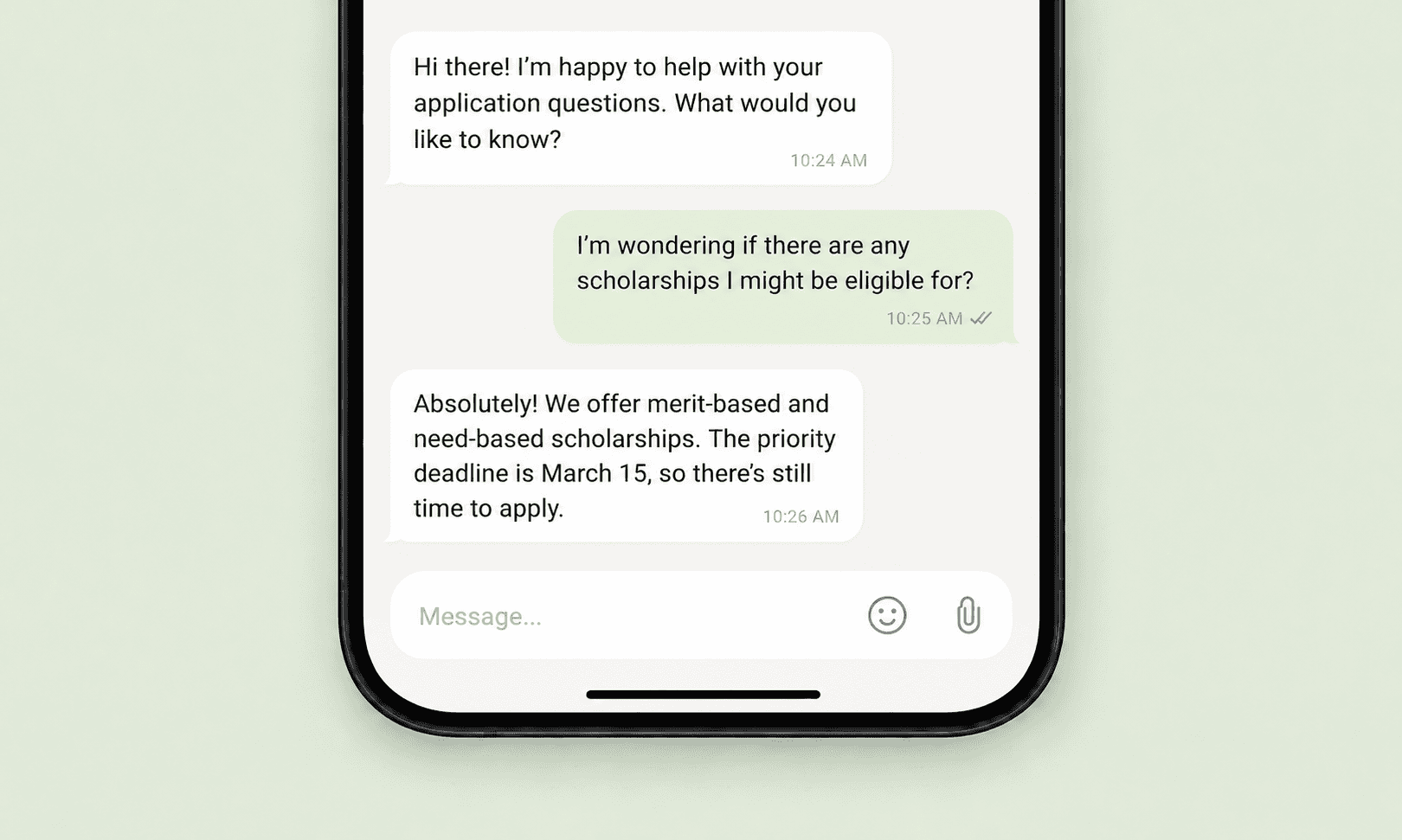
This question does several things simultaneously. It extends the conversation beyond the physical visit. It gives students who did not get to ask their question a second chance to do so. And it produces structured data — programme interest, concerns, enthusiasm level — that your follow-up sequence can use to personalise the next seven days of communication.
Response rates are high because the message arrives at exactly the moment students are reflecting on what they experienced.
The Two-Hour Window
In the first two hours after leaving campus, students are still emotionally activated by the visit. They are comparing notes with family or friends. They are making mental rankings. A message that arrives in this window lands while those comparisons are still in progress.
A follow-up sent the next morning competes with a full night of sleep, other decisions, and outreach from competing institutions. The same message has materially different conversion power depending on when it arrives.
For institutions running high-volume open days, the two-hour window requires automation — no human team can send personalised follow-ups to hundreds of attendees while also running the event itself. This is where AI agents handle the operational lift.
The 7-Day Post-Visit Sequence
Day | Message | Goal |
|---|---|---|
Day 0 (same evening) | Warm close to the day — brief, personal, reference something from intent capture | Re-affirm the connection while it's fresh |
Day 2 | One genuinely useful piece of info about the programme they flagged | Build on their expressed interest |
Day 5 | Application timeline — clarity on deadline and process, not pressure | Move from interest to intent |
Day 7 | Low-pressure check-in — invite a reply without requiring one | Keep the door open |
This sequence should adapt based on whether the student has responded. A student who replied on day zero with enthusiasm needs a different day-two message than one who has not responded at all. AI-driven sequences handle this branching logic at scale.
How AI Agents Handle This at Scale
A well-configured AI agent can manage the entire open day WhatsApp sequence for hundreds of attendees simultaneously, personalising each message based on programme interest, response history, and engagement signals. Specifically, the agent:
Sends day-zero outreach as attendees leave the event
Processes intent capture responses and routes each student to the right follow-up track
Escalates to a human counsellor when a student signals readiness to apply or raises a complex question
Maintains a clean CRM record of every interaction
The operational case is straightforward: no human team can deliver a two-hour follow-up to 300 attendees while also running the event itself. The quality case is equally strong — an AI agent does not get tired at the end of a long open day, does not send the wrong template to the wrong student, and does not forget the day-five message.
Frequently Asked Questions
What should we do with open day no-shows?
No-shows are a separate segment with meaningful conversion potential. A student who registered but did not attend has still expressed intent. A WhatsApp message sent the day after — acknowledging that life happens and offering a short virtual alternative or a campus visit booking — converts a meaningful proportion of no-shows into rescheduled visits. Treat them as warm leads, not lost ones.
How do we personalise follow-up if we do not know what each student saw during the day?
The intent capture question sent as students leave is the primary tool. If a student does not respond to that question, fall back to personalisation based on registration data — the programme they selected when they signed up or the sessions they were scheduled to attend. Even programme-level personalisation is significantly more effective than fully generic follow-up.
Is WhatsApp appropriate for all age groups attending open days?
For undergraduate prospective students aged 17 to 22, WhatsApp is the dominant communication channel in most markets. For postgraduate and mature student audiences, the preference is more varied — email remains relevant, and some postgraduate prospects prefer a phone call. Collect channel preference at registration where possible, and use WhatsApp as the default for undergraduate events while offering an email alternative for postgraduate and executive education programmes.
How many messages is too many in the post-visit sequence?
Four to five messages over seven days sits at the upper limit for most students without feeling intrusive, provided each message contains something of genuine value. The sequence tips into nuisance territory when messages arrive daily, repeat the same ask, or are clearly template-based with no personalisation. Quality and relevance matter far more than frequency.
What happens if a student replies and says they are not interested?
Respect the signal immediately and without friction. A single reply acknowledging their response and closing the conversation politely is the right end to the sequence. Do not attempt to re-open the conversation. Move the record to an opted-out segment and ensure the student does not receive further outreach. Handling this well protects your sender reputation — and occasionally produces a referral from a prospect who appreciated being treated respectfully even in decline.