Carlos Delgado
Traditional lead scoring was built for web forms and email MQLs, where data is static and scoring can run overnight.
WhatsApp moves faster. Leads arrive with nothing but a phone number, and the conversation itself is the real source of intent data.
The result: scoring models designed for a CRM form field collapse the moment they hit a live WhatsApp thread, and the teams still using them leak revenue every hour.
Quick Answer
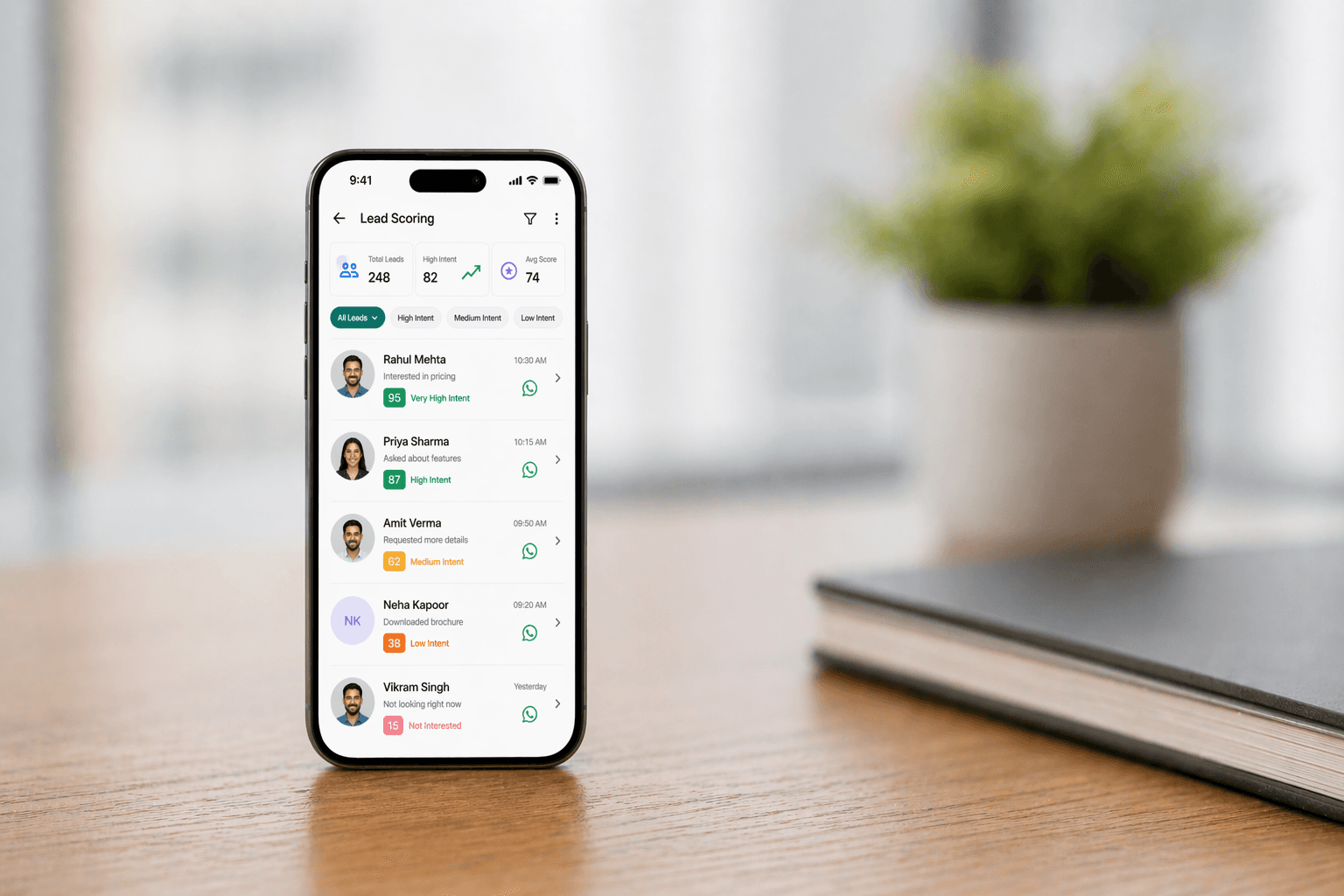
WhatsApp lead scoring is the practice of assigning a real-time numeric score (0–100) to each WhatsApp conversation based on signals pulled from the chat itself (reply speed, intent keywords, sentiment, volunteered context, objections, and calendar interest) rather than static CRM fields. The top-scoring leads are routed to human reps, while the rest stay with an AI agent that continues nurturing and re-scores after every inbound message.
How WhatsApp Lead Scoring Differs from Traditional Lead Scoring
The goal, focus reps on the hottest leads, is identical. The inputs, timing, and outputs are not.
Traditional Lead Scoring | WhatsApp Lead Scoring | |
|---|---|---|
Data source | Form fields, firmographics | Conversation signals |
Update frequency | Nightly batch | After every inbound message |
Signal quality | Declared (what the lead says they do) | Revealed (what the lead actually does) |
Coverage | Fields the lead filled in | Every message in the thread |
Languages | Single-language rule sets | 80+ languages via LLM extraction |
The biggest difference is revealed vs declared data. A lead who writes "I need a 2-month program starting in September and my budget is around €3k" has told you more in one message than most forms ever capture, and a WhatsApp-native model reads it automatically.
Step-by-Step: Building a WhatsApp Lead Scoring Model
Capture every message back to the CRM: Both inbound and outbound messages need to be written to the contact record. Without full conversation data, scoring has no substrate and reps lose context between handoffs.
Pick 5–8 signals, not 50: Start with reply speed, intent keywords, message specificity, objection type, volunteered information, calendar intent, and sentiment. More signals sound smarter but add noise and slow iteration.
Weight the signals: Assign each signal a weight that sums to 100. A typical split: calendar intent 30, intent keywords 20, reply speed 15, specificity 10, objection type 10, volunteered info 10, sentiment 5. Adjust based on your sales cycle.
Define thresholds with clear actions: 80–100 routes to a human rep immediately. 50–79 stays with the AI agent for deeper qualification. 20–49 gets a lighter nurture cadence. 0–19 is archived or moved to re-engagement.
Re-score after every message: A static score is a dead score. Every inbound message should trigger a re-score so that a lead who heats up gets routed within seconds, not the next morning.
Retrain weekly: Pull the conversations that converted vs the ones that didn't, and adjust the weights. A lead scoring model that never changes never improves.
3 High-Performing WhatsApp Lead Scoring Use Cases
Inbound high-volume B2C
Education, fitness, delivery, and similar B2C verticals where thousands of WhatsApp leads arrive monthly from paid ads or organic sign-ups. Scoring filters the noise so reps only talk to the 10–20% most likely to close.
Click-to-WhatsApp ads
Meta Click-to-WhatsApp campaigns produce huge lead volume at uneven quality. Real-time scoring catches the high-intent leads inside the ad-session window and books them before they cool off.
Re-engagement of dormant contacts
Old leads that went silent can be re-scored after a re-engagement message. A quick, specific reply bumps the score and pulls the contact back into active pipeline without a rep ever touching it.
Mistakes That Break Your Lead Scoring Model
Scoring only on declared data: Ignoring the conversation and scoring off CRM form fields alone throws away the strongest signal WhatsApp gives you. If your model would work the same without the chat, it's not a WhatsApp model.
Updating scores in batches: Nightly scoring misses the WhatsApp window entirely. By 9 a.m. the lead has already been closed by a competitor who replied at 8:47 p.m.
Weighting too many signals equally: Flat weights let weak signals (e.g. emoji use) dilute strong ones (e.g. calendar intent). Assume one or two signals carry most of the predictive load and weight accordingly.
No feedback loop: Without comparing scores against actual conversion outcomes each week, the model drifts. A scoring system that isn't retrained is just expensive opinion.
WhatsApp lead scoring works because the channel hands you the signal your CRM forms were never going to capture, what the lead actually says, how fast, and how specifically.
But the signal is only useful if it's extracted from every message, scored in real time, and tied back to a clear routing action.
Teams that get this right end up with reps who only ever speak to warm leads, response times under a minute, and conversion rates that climb without adding headcount.