Carlos Delgado

A Saturday night in admissions
It's 8:47pm on a Saturday. A 17-year-old finishes a campus tour video on TikTok, opens your university's website, and fills out an inquiry form. She's serious, she's been thinking about this for weeks. She also has the websites of three other universities open in other tabs.
She submits the form. She gets an auto-reply that says "Thank you for your interest. A member of our admissions team will be in touch within one business day."
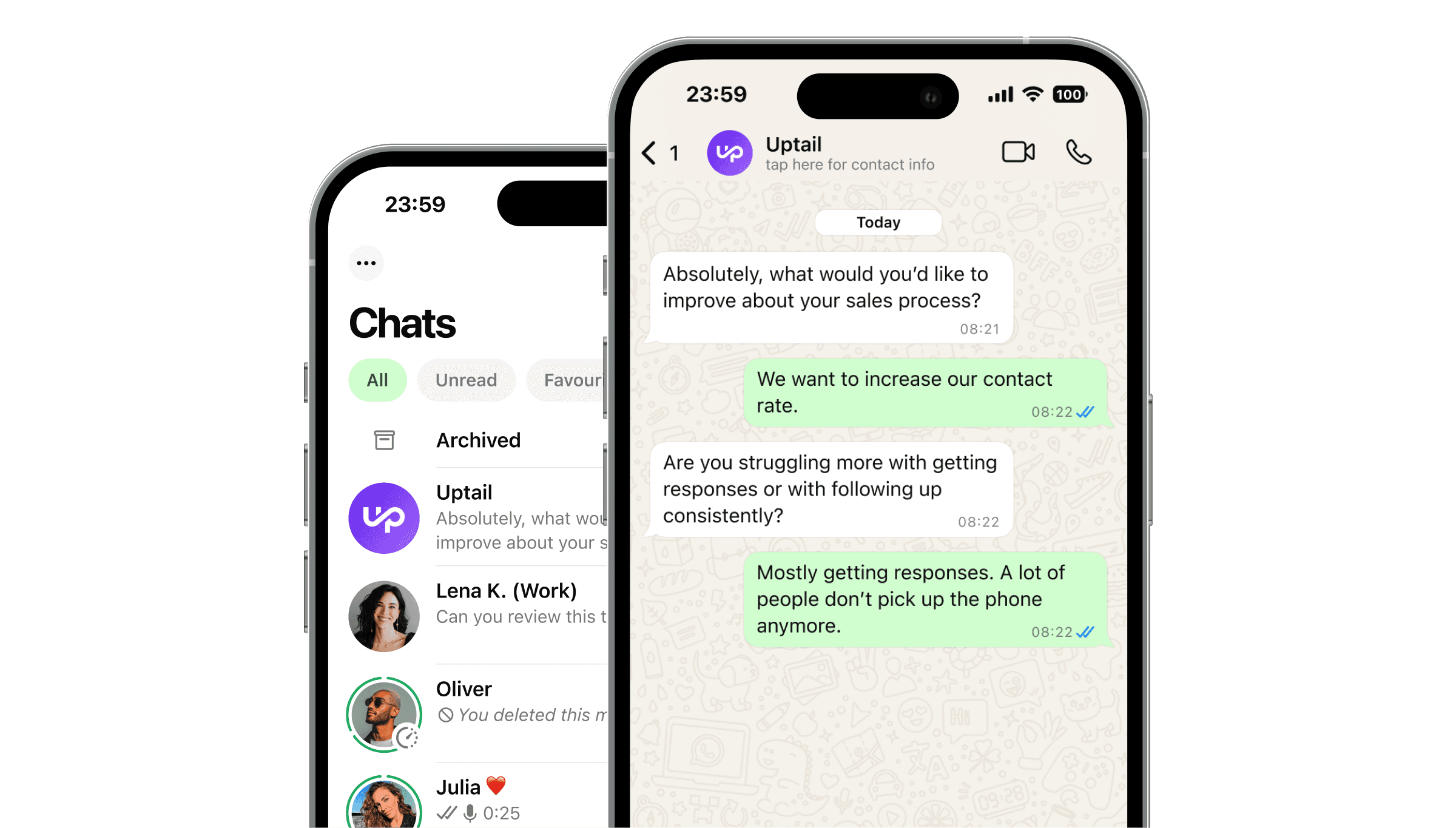
She submits two more forms on two other school websites. One of them replies in 42 seconds with a real conversation on WhatsApp, asks her two questions, and books her into a virtual info session for Tuesday evening.
By Monday morning, when your admissions team opens their inboxes, she's already made up her mind about which school she's most excited about. And it isn't yours.
This is happening at your institution, every weekend, and the cost is bigger than most enrollment leaders realize.
The 25% you don't see
Across higher education, roughly 25% of inbound inquiries arrive outside standard office hours — evenings, weekends, holidays. For a university generating 30,000 inquiries a year, that's 7,500 prospective students who first interact with your institution when no one is there to respond.
Industry data is unambiguous on what happens next. Conversion rates on after-hours inquiries run roughly 4 percentage points lower than inquiries received during office hours — 8% versus 12% for a typical institution.
That isn't because after-hours inquiries are lower quality. It's because by the time anyone replies, the student has had 12–60 hours to talk to a competitor, lose interest, or simply forget which school sent which brochure.
What a 4-point gap actually costs
Let's run the math on a mid-sized institution.
Office hours leads | After-hours leads | |
|---|---|---|
Annual inquiries | 22,500 | 7,500 |
Conversion rate | 12% | 8% |
Enrollments | 2,700 | 600 |
Revenue (at €2,000/enrollment) | €5.4M | €1.2M |
Now imagine the after-hours conversion matched office hours.
After-hours leads | Conversion rate | Enrollments | Revenue | |
|---|---|---|---|---|
Today (M–F coverage) | 7,500 | 8% | 600 | €1.2M |
If after-hours matched office hours | 7,500 | 12% | 900 | €1.8M |
Difference | +300 | +€600,000 |
That 4-point gap costs you 300 enrollments and €600,000 every year. 300 enrollments is roughly an entire incoming class for a small program. €600,000 is more than most institutions spend on their entire digital recruitment budget.
Why your team isn't to blame
The instinct when seeing those numbers is "we need to staff weekends." That's reasonable, and also harder than it sounds:
Weekend staffing is structurally difficult. Qualified admissions counselors are hard to find at any time. Asking them to work Saturdays and Sundays means premium pay, faster burnout, and constant recruiting. Most institutions try this for a quarter and roll it back.
Outsourcing breaks the experience. Offshore call centers can fill the time slot, but they can't speak to your specific programs, your tuition structure, or your campus culture. Prospective students notice immediately, and the conversion lift is smaller than expected.
The window is shorter than you think. When a student fills out an inquiry form, your institution is the most exciting school on their list, for about an hour. After that, the next school they look at becomes the new shiny option. By Monday morning, you're not the first reply, you're the fourth.
So this isn't a problem your admissions team can fix by working harder, and it isn't a problem you can throw cheap labor at. It's a structural problem about when the conversation has to happen.
What "always-on admissions" actually looks like
There are three realistic ways to close the after-hours gap. The trade-offs matter.
Option 1: Hire more weekend staff
The traditional answer. Adding human coverage on Saturdays and Sundays can lift after-hours conversion from 8% to roughly 10–11%. Real, but expensive, premium pay, higher turnover, training overhead, and you're still capped by how many conversations one human can handle in an hour. Best case, you recover about half the gap.
Option 2: Basic chatbots
The cheap answer. A scripted chatbot collects email addresses and sends a "we'll be in touch Monday" message. Cost is low. Lift is small, maybe 8% to 9–10%, almost entirely from capturing contact details that would otherwise have been lost. The user experience is poor enough that you can sometimes lose more goodwill than you gain.
Option 3: AI agents
The newer answer. A conversational AI agent on WhatsApp or your website replies in under a minute, qualifies with two questions, answers basic program and tuition questions in your institution's voice, and books the student into a real conversation with a human admissions counselor for Monday morning. After-hours conversion typically rises to 11–12% — close enough to office-hours performance that the gap effectively closes.
Cost is medium, and unlike Option 1, it scales without adding headcount. Unlike Option 2, the student actually has a useful conversation. The human admissions counselor inherits a qualified lead with full context, not a name on a list.
Strategy | Conversion rate | Cost | Recovers full gap? |
|---|---|---|---|
Hire weekend reps | 8% → 10–11% | High | About half |
AI agents | 8% → 11–12% | Medium | Yes |
Basic chatbots | 8% → 9–10% | Low | A quarter |
The math for your institution
The formula is straightforward enough to run on the back of a napkin:
Annual after-hours revenue gap = After-hours leads × (Office CR − After-hours CR) × Revenue per enrollment
For the 30,000-inquiry example above: 7,500 × (0.12 − 0.08) × €2,000 = €600,000.
Plug in your own numbers. If you generate 10,000 inquiries a year, the gap is €200,000.
If you generate 60,000, it's €1.2 million. The point isn't the exact figure — it's that this is one of the few funnel improvements where the math is unambiguous and the cause is operational, not strategic.
What to do this week
If you're an enrollment leader and the numbers above look anything like yours, three concrete moves are worth a week of your time:
Measure the gap. Pull your CRM data and split conversion rates by inquiry timestamp, office hours versus after-hours, weekday versus weekend. Most teams haven't run this analysis and are surprised by the result.
Time your response speed. Drop a test inquiry on your own website on a Saturday evening. Time how long it takes for a human to reply. If the answer is "Monday afternoon," your competitors already know.
Decide which option fits. Hiring weekend staff is reasonable for some institutions. AI agents are reasonable for most. Doing nothing is reasonable for none, the gap doesn't shrink on its own, and competitors who close it first get the compounding benefit every cycle.
The bottom line
The hardest part of fixing weekend admissions isn't picking a solution, it's accepting that the rules have changed. Prospective students used to wait for your reply because they had to. They don't have to anymore. The school that replies first, in the channel the student already uses, with a real conversation instead of an auto-reply, wins disproportionately.
The school that waits until Monday loses 1 in 4 of its best leads, every weekend, all year long.
That's the €600,000 question. And it gets more expensive every year you don't answer it.
Curious what your institution's after-hours gap actually costs? Run your numbers here, or book a strategy call and we'll walk through your funnel together.