Carlos Delgado

Quick Answer
Admissions teams lose most leads in the first 48 hours because they respond too slowly and open with the wrong message. The fix is a sub-five-minute first contact that names the specific programme, asks one qualifying question, and arrives via the channel the student already uses.
When a prospective student submits an enquiry form, they are at peak motivation. They have just searched for something they want, made a decision to act, and handed over their contact details. That moment is brief. Within hours, competing priorities crowd in, other institutions, work, life, and the window for easy conversion begins to close.
Most admissions teams do not respond in that window. Some respond within hours. Many respond the next day. A significant number respond later still, with an automated email that reads like it was written for everyone and no one in particular. By then, the student's motivation has decayed, a competitor has likely already been in touch, and the psychological moment of genuine openness has passed.
What Happens to a Lead in the First 48 Hours
Motivation is not a stable state. The impulse that drives a prospective student to submit an enquiry form is tied to a specific moment: something they read, a conversation they had, a deadline they became aware of. That impulse is strong when they hit submit. It weakens with each passing hour.
Research on lead response across sectors consistently shows the same pattern: the probability of meaningful engagement drops sharply in the first hour and continues to fall through the first day. By 48 hours, a lead that could have converted with a well-timed response may require five or six touchpoints to achieve the same outcome, if it converts at all.
Competing institutions accelerate this decay. If another school responds within minutes and yours responds the next morning, the prospective student has already had a conversation that shaped their impressions. Your response arrives into a context that has already shifted.
The Two Failure Modes
Slow first contact is the more obvious failure, but the wrong first message is equally damaging and far more common. A generic first response, one that thanks the student for their interest, lists several programmes, and encourages them to visit the website, is the worst outcome from a fast response. It signals that the institution processes enquiries, not students.
The two failure modes compound each other. A slow generic response is the most damaging combination. A fast generic response is better than nothing but still leaves significant conversion on the table. Only a fast, specific, relevant response captures the full opportunity.
Why Email Fails in This Window
Email is the default first-response channel for most institutions. It is also poorly suited to the 48-hour window for three structural reasons.
First, read rates for marketing and enquiry-related emails have declined significantly. Open rates for educational institution emails typically sit between 20 and 35 percent, meaning the majority of students who enquire will not read the first email response at all. Second, email is asynchronous by nature, it creates no conversational momentum, no sense that a person is present and waiting. Third, younger prospective students have shifted their primary communication to messaging channels. An email response to a WhatsApp-native student is already working against the grain.
The 5-Minute Benchmark
The data on response time thresholds is unambiguous. Responding within five minutes of an enquiry produces significantly higher engagement rates than responding within thirty minutes, which produces significantly higher rates than responding within an hour. After 60 minutes, the conversion advantage of speed narrows to the point where other variables begin to dominate.
Five minutes is not achievable through manual processes alone. The institutions that consistently hit the five-minute benchmark are using automated or AI-assisted first-contact systems that respond immediately with programme-specific content and a qualifying question, triggering a human handoff once the student replies.
What the First WhatsApp Message Needs to Do
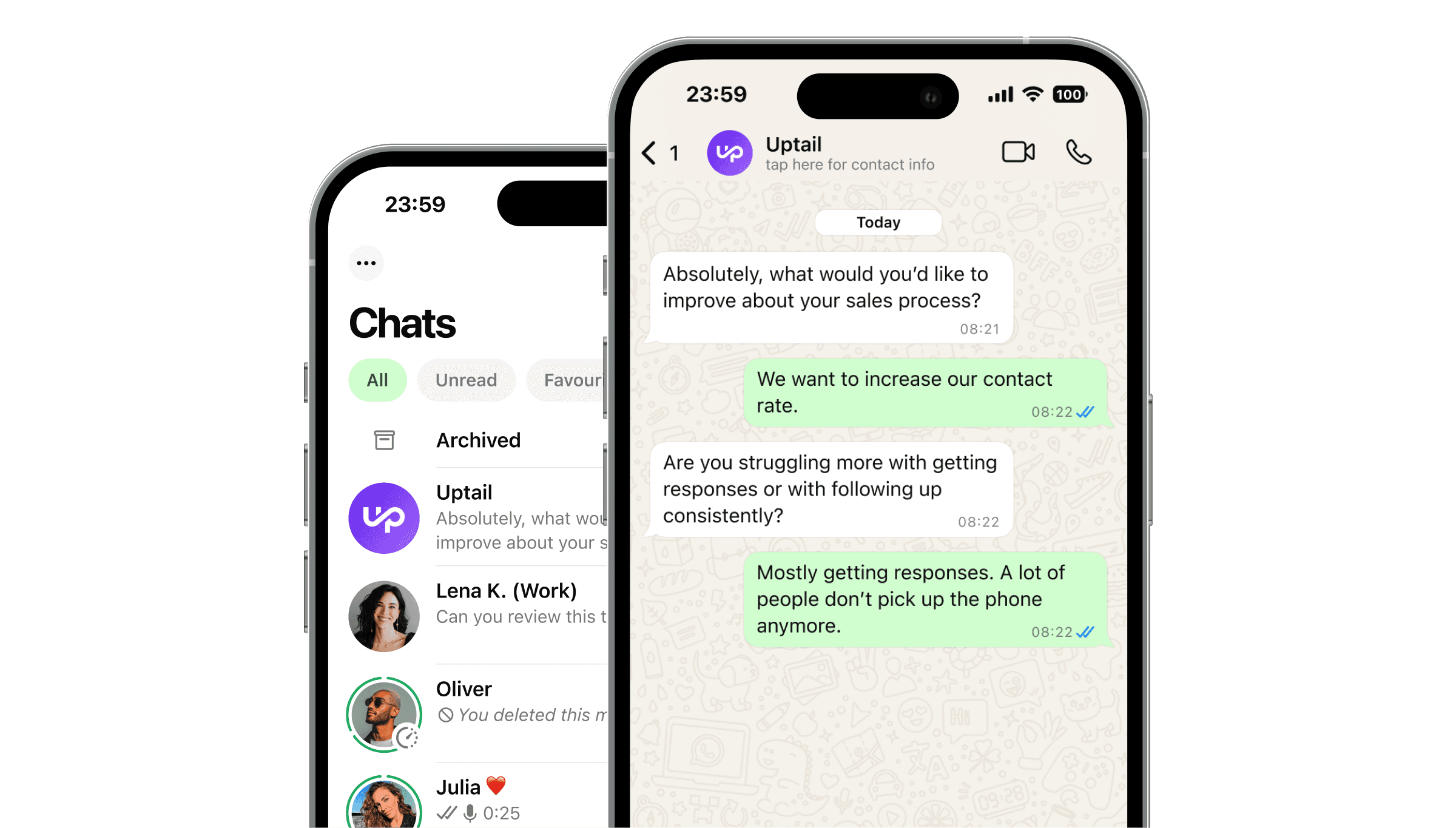
The first message in a conversational channel needs to accomplish three things: acknowledge the specific programme the student enquired about, open with a question rather than an information dump, and arrive in a format that invites reply rather than filing.
Under 134 characters is the practical target for a first WhatsApp message. At that length, the entire message is visible in the notification preview without requiring the student to open the app. A message that reads "Hi [name], thanks for your interest in our MBA programme, are you looking to start this September or further ahead?" is more effective than a paragraph about the programme, the institution's ranking, and an invitation to book a tour.
How AI Agents Close the 48-Hour Gap
The five-minute benchmark requires infrastructure that most admissions teams cannot sustain manually. AI agents address this by responding to enquiries in under 60 seconds, 24 hours a day, seven days a week, with programme-specific context drawn directly from the enquiry form.
When a student submits a form indicating interest in a part-time Master's programme, an AI agent can pull that programme context, construct a relevant first message, send it via WhatsApp within seconds, and route the conversation to the appropriate counsellor once the student replies.
The admissions rep inherits a warm conversation with a qualified student, not a cold enquiry in an inbox. The value is not just speed, it is consistency across evenings, weekends, and peak intake periods.
Frequently Asked Questions
What if some students genuinely prefer email?
A small segment of prospective students, typically mature students, career changers, and international applicants navigating formal processes, do prefer email. The right approach is to mirror their channel: if the enquiry came via email, respond via email, but respond quickly and with specificity. For students who have provided both email and phone details, lead with the conversational channel and follow up on email if there is no response within 24 hours.
How should admissions teams handle weekend and overnight enquiries?
This is precisely where AI-assisted first contact pays the most. Weekend and overnight enquiries represent a significant portion of total volume, particularly from students who research during personal time. Without an automated response system, these enquiries sit until Monday morning, by which time competing institutions that do have weekend coverage have already established a relationship.
Does speed matter more than message quality?
Neither speed nor quality alone is sufficient, both matter, and they interact. A fast generic message performs better than a slow generic message, but a fast specific message outperforms both by a significant margin. If forced to prioritise, speed has a larger impact in the first five minutes, and quality matters more progressively after that.
How do we measure whether our 48-hour response process is actually working?
Track three metrics: average first response time, reply rate on first contact, and enquiry-to-visit conversion rate segmented by response time bucket. The last metric is the most revealing, it lets you see directly whether students who receive a five-minute response convert at higher rates than those who wait an hour or more.
Can a faster response feel pushy or desperate to prospective students?
Done well, speed signals attentiveness, not desperation. The difference lies in the tone and content of the message. A response that arrives in two minutes and says "Hi [name], saw your interest in our Business programme, are you thinking about September intake?" reads as responsive and engaged. A response that uses urgency tactics regardless of timing reads as pressure. Students respond positively to institutions that pay attention and respond quickly with relevant information.