Carlos Delgado
Why International Student Inquiries Die in Email (and What to Do About It)
Quick answer
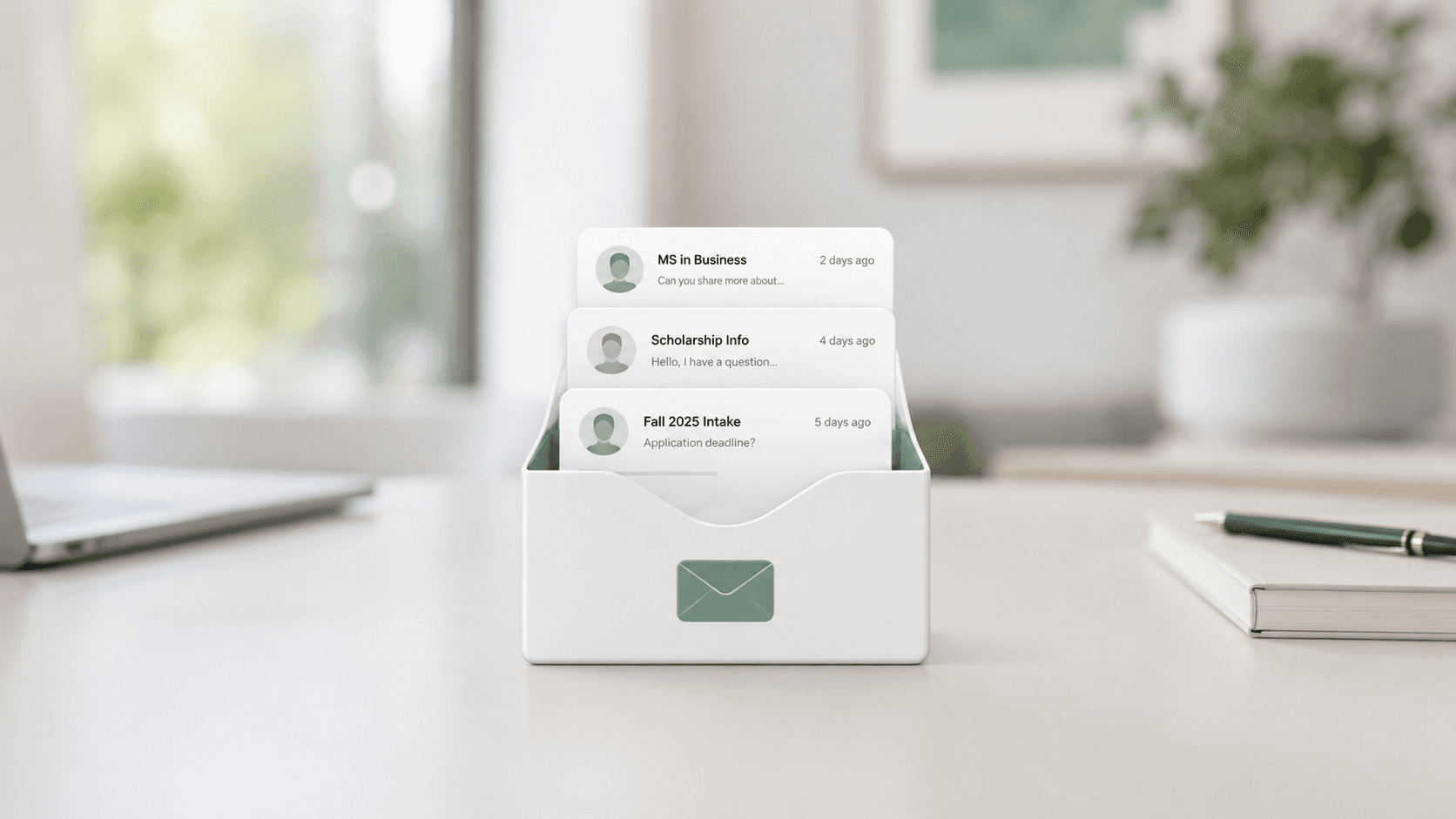
International student inquiries reply at much higher rates on WhatsApp because email is not the primary personal inbox in most international source markets, LATAM, India, Indonesia, Sub-Saharan Africa, and Southern Europe. In regions where WhatsApp is the default messaging app, routing admissions follow-up there is the highest-leverage channel change a school can make.
Here's a question every admissions director should ask: "What's our email reply rate on inquiries from Mexico?"
If the answer is below 10%, the channel is broken, not the prospects.
The channel-mismatch problem
Most international student recruitment funnels look like this: a prospect fills out a form on your website, you send them an email, and you wait. In Boston, that works. In Bogotá, it doesn't.
Across these markets, LATAM, India, Indonesia, Sub-Saharan Africa, and Southern Europe, email is a work account or a username for signing up to services. It is not a place where personal conversations happen.
Where WhatsApp is the default inbox
WhatsApp penetration as the primary messaging app, grouped by region:
Brazil: 79%
Mexico: 72%
India: 83% (Gen Z heavily WhatsApp + Instagram)
Indonesia: 51%
Time zones stop being a problem
A Mumbai prospect inquiring at 3pm local time is asking your Boston admissions team at 5:30am ET.
By the time someone replies at 9am ET, it's 6:30pm in Mumbai and the prospect is having dinner.
An AI WhatsApp agent answers within seconds, in Hindi, Portuguese, Spanish, Bahasa Indonesia, English, regardless of where your team sleeps. The next morning your advisor wakes up to a calendar of qualified prospects instead of an inbox of unanswered inquiries.
This isn't a productivity story, it's a coverage story. Without AI on WhatsApp, your international funnel is leaking every night, across every region where WhatsApp is the default inbox.
Why prospects answer WhatsApp and not email
In the markets where international student recruitment matters most, WhatsApp isn't a "second channel." It's the primary communication app.
That changes how a message reads. An email from a foreign university lands in the same inbox as bills, password resets, and marketing newsletters, most of which the recipient ignores by habit. A WhatsApp message lands in the same thread as their family group chat, their work conversations, and their close friends. It gets read. It usually gets a reply.
That's the behavioral asymmetry. It's why moving the channel matters more than improving the copy.
How to migrate without breaking your CRM
Add WhatsApp to your inquiry form as an optional but prominent field
Get explicit opt-in to message on WhatsApp (compliance + deliverability)
Route opt-in inquiries to a WhatsApp AI agent for first touch
Sync the WhatsApp conversation log back to your CRM (Salesforce / HubSpot / Zoho) as a contact activity
Keep email as a fallback channel, not the primary one
The technical lift is two to four weeks. The hard part is internal, getting admissions, marketing, and IT aligned on WhatsApp as a real channel, not a side experiment.
Frequently Asked Questions
Do international students have WhatsApp Business installed?
No, and they don't need to. They have regular WhatsApp. You message them from your WhatsApp Business API number.
Doesn't this break compliance?
No, if you collect explicit opt-in and use the official WhatsApp Business API (not the consumer app). We cover compliance separately.
Can the AI agent handle 5+ languages?
Yes. One agent, language-detected on the first message, can hold a fluent conversation in Spanish, Portuguese, English, Hindi, and Arabic, see our multilingual agent post.
What about US-domestic recruitment?
WhatsApp is weaker in the US. For US-domestic, SMS is the closest analog. The framework is the same, just substitute SMS for WhatsApp.