Carlos Delgado
Why Your University's WhatsApp Number Needs Verification Before You Run Admissions Campaigns
Quick Answer
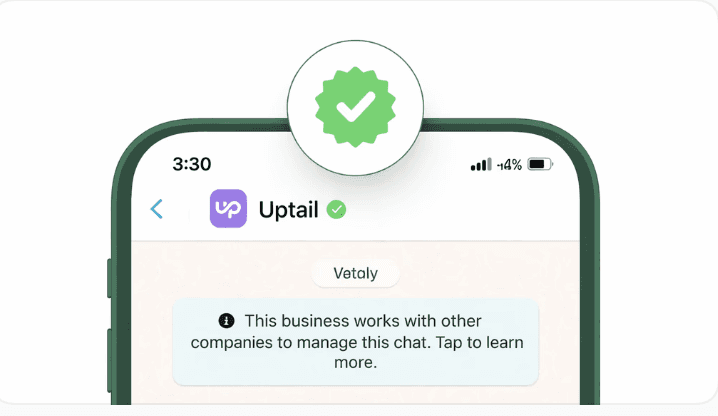
The WhatsApp verified badge (blue checkmark next to your institution's name) tells students the account is legitimate. For admissions teams, it's not a vanity feature, it directly affects whether prospective students open messages, share documents, and trust your outreach enough to act on it.
Students receive WhatsApp messages from fake enrollment agents constantly. Fraudulent numbers impersonating universities, offering "guaranteed admission," harvesting personal data. When your institution's WhatsApp number looks identical to one of those, no badge, name only visible to saved contacts, you've already lost the trust battle before the conversation starts.
Verification fixes that. Here's what admissions teams need to know.
What the Verified Badge Actually Is
The badge appearing next to your institution's display name is called the Official Business Account (OBA) status. Meta awards it after verifying that the account belongs to a legitimate, notable organization. Once verified:
Your institution's name appears to all recipients, including students who haven't saved your number
Your account becomes discoverable in WhatsApp search
A blue checkmark badge appears next to your name in every conversation
Impersonation of your account becomes significantly harder
International students who've been warned by their networks to verify an institution's identity before engaging, a badge removes the doubt instantly.
Why This Matters Specifically for Admissions
Admissions involves sharing sensitive information: A prospective student you're qualifying over WhatsApp will eventually need to send transcripts, share financial aid documents, confirm identity details. The moment of hesitation, is this actually the university, or is this a scammer?, kills conversion.
International students are the highest-risk group for trust friction: Students from South Asia, West Africa, Southeast Asia, and Latin America are specifically targeted by fraudulent agents on WhatsApp. A badge removes the doubt instantly. No badge means extra friction, slower responses, and higher drop-off.
Verified accounts also see higher open rates and reply rates compared to unverified accounts sending the same message content.
Two Paths to Verification
Path | Cost | Timeline | Best For |
|---|---|---|---|
Free OBA route | No direct fee | 2–8 weeks | Universities with media coverage and strong brand presence |
Paid monthly | Hours to a few days | Smaller colleges, branch campuses, faster timeline |
What "Notability" Means, and What Counts
The free OBA route requires Meta to find evidence that your institution is a known, legitimate organization:
Press coverage in third-party publications: news articles, education publications, national rankings mentions
Wikipedia page (weighted heavily)
Official partnership announcements with accrediting bodies, government agencies, or major employers
Rankings inclusions: QS, Times Higher Education, US News, etc.
Three to five strong external references are typically sufficient for an established university. If your institution doesn't have sufficient notability evidence, the paid Meta Verified route bypasses this requirement.
Step-by-Step: Getting Your Institution Verified
Step 1: Get WhatsApp Business API access
Verification is only available through the API. The free Business App does not qualify. You'll need a BSP like Uptail to set up your API account.
Step 2: Complete Meta Business Manager verification
Submit official business registration documents, confirm your business address, and ensure a verified admin account.
Step 3: Enable two-factor authentication
Required for all OBA applications.
Step 4: Choose your verification path
For the free OBA route, compile notability evidence: press links, Wikipedia URL, ranking citations. Submit through Meta's OBA application process. For Meta Verified, subscribe through Meta Business Suite.
Step 5: Submit and wait
Free OBA review: 2–8 weeks. Meta Verified: hours to a few business days.
What Happens During Admissions Campaigns Without the Badge
Without a badge, that message comes from an unknown number with no visible institution name. To a student already on guard against fraudulent agents, it looks identical to a scam. Read rates drop. Replies slow down. Qualified leads go cold.
With the badge, the same message arrives under your institution's verified name with a blue checkmark. Context is instant. Trust is pre-established.
Branch Campuses and Multi-Campus Institutions
Each WhatsApp number requires its own verification. A branch campus operating a separate admissions number needs to apply independently. The badge does not transfer across phone numbers. For institutions managing multiple campuses each with their own WhatsApp presence, the verification process runs per-number.
Frequently Asked Questions
Does a university automatically qualify for the free OBA verification?
No. An established research university with strong press coverage will almost certainly qualify. A newer regional college with limited third-party coverage may need to pursue Meta Verified instead.
What about smaller community colleges?
Community colleges with limited press coverage are strong candidates for the paid Meta Verified path. The subscription cost is relatively low and the timeline is much faster.
Can a branch campus get its own verified badge?
Yes, but the badge is tied to the specific phone number, not the institution. Each branch campus number needs its own application.
Does the badge transfer if we change our WhatsApp number?
No. Verification is tied to the specific phone number. Changing numbers requires re-verification — another reason to establish a dedicated, permanent admissions number before applying.
Does the badge affect message delivery rates?
Indirectly. Verified accounts are less likely to be reported as spam, which protects your sending reputation. A clean sending reputation contributes to consistent delivery.