Carlos Delgado
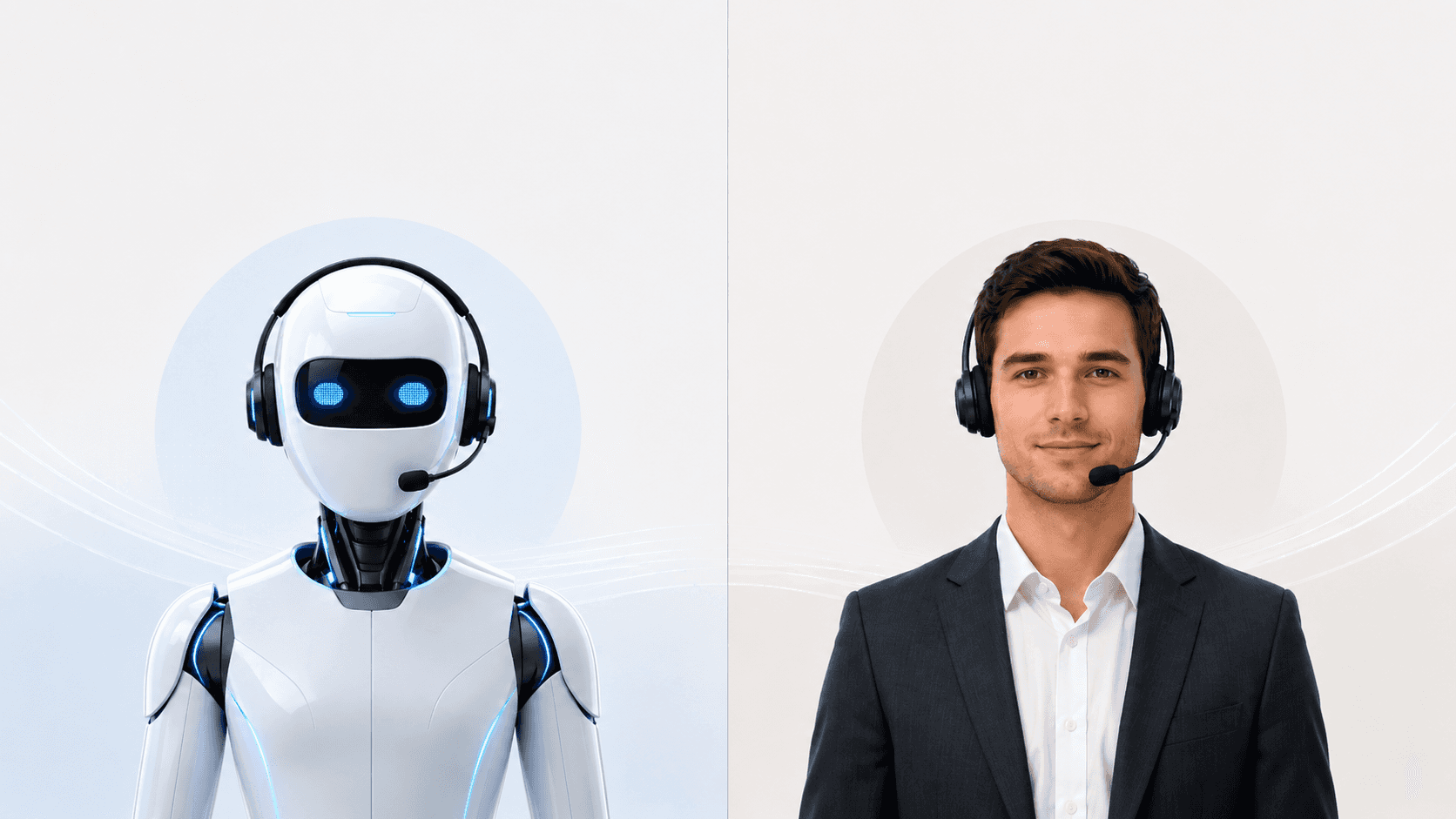
In 2026, the debate between AI SDRs and human SDRs is not about which one is better in the abstract. It is about which one is right for a specific motion, a specific volume, and a specific type of buyer.
Quick Answer
AI SDRs handle first-touch, qualification, and booking in seconds at a fraction of the cost of a human rep, making them the superior choice for high-volume B2C inbound in 2026. Human SDRs still outperform on complex enterprise sales and late-funnel relationship closing. The highest-performing teams use a hybrid model: AI qualifies at speed, humans close with context.
AI SDR vs Human SDR: Definition and Cost Comparison
An AI SDR is a software agent, typically LLM-based, that handles the outreach, qualification, and booking steps that a junior human sales rep would otherwise perform. It reads inbound intent signals, sends personalised first messages, asks qualification questions, handles objections within a defined script, and books a meeting on a human rep's calendar. It operates 24/7, in 80+ languages, at the cost of the outcome rather than the hour.
A human SDR is a junior salesperson, typically 1-3 years of experience, doing the same tasks manually. They work 8-9 hours a day, in one or two languages, and their performance varies with energy level, motivation, and tenure.
Metric | Human SDR | AI SDR |
|---|---|---|
Fully-loaded annual cost (EU) | €45,000-70,000 | Pay-per-outcome (no fixed cost) |
First-response time | Minutes to hours | Seconds |
Coverage | Business hours only | 24/7/365 |
Languages | 1-3 | 80+ |
Consistency | Variable (fatigue, mood, tenure) | Consistent at scale |
Capacity per day | 60-100 touches | Unlimited |
Qualification depth | High (nuanced) | High (structured) |
Relationship building | Strong | Weak |
Complex objection handling | Strong | Moderate |
The cost comparison is not close for high-volume B2C inbound. A human SDR handling 200 inbound leads per month costs €3,500-5,800 per month in fully-loaded salary.
An AI SDR operating on pay-per-performance pricing charges only when a lead converts into a booked call or qualified appointment. If the AI books 40 calls per month, the cost is 40 outcomes, not 160 hours.
Step-by-Step: How to Decide Between AI SDR, Human SDR, or Hybrid
Audit your lead volume and hours: If inbound lead volume exceeds 150 per month or if more than 25% of leads arrive outside business hours, the human SDR model has a structural gap. Map when leads arrive, not just how many.
Define what "qualified" means precisely: A qualified lead in real estate means: confirmed budget range, confirmed buying timeline under 90 days, confirmed location preference. Write that definition down. If the qualification criteria are structured and repeatable, an AI SDR can execute them reliably. If qualification requires reading between the lines on ambiguous enterprise requirements, a human does it better.
Calculate your current cost per qualified lead: Take total SDR payroll (salary, benefits, management overhead, tools) and divide by the number of qualified leads delivered in the last quarter. This is the baseline the AI SDR has to beat. For most B2C companies, this number is €80-250 per qualified lead from an outbound SDR team.
Identify your after-hours lead bleed: Pull the timestamp data on inbound form fills for the last 90 days. If more than 30% arrive between 6pm and 9am, that is revenue leaving uncaptured every single night. An AI SDR recovers that pipeline without adding headcount.
Design the handoff protocol: The AI SDR's job ends when the lead is qualified and the meeting is booked. The human rep's job begins at that point. The handoff should include a structured summary: lead name, channel, qualification answers, urgency signals, and any objections raised. This goes into the CRM automatically before the rep picks up the call.
Run a parallel test for 60 days: Route 50% of inbound B2C leads to the AI SDR and 50% to the human SDR team. Measure response time, qualification rate, booking rate, and show rate. The data will make the channel allocation decision obvious.
3 Contexts Where Each Model Wins
High-Volume B2C Inbound: AI SDR Wins
A company receiving 500 inbound leads per month across WhatsApp, web forms, and social ad clicks cannot staff a human team to respond to all of them within 60 seconds. The math does not work. AI SDRs respond in seconds, qualify inline, and book meetings without the lead waiting.
The Glovo sales team described the shift as efficiency doubling, equivalent to running a 24/7 sales rep who never sleeps and never loses enthusiasm. The volume that would require three human SDRs during business hours is handled by one AI agent around the clock.
Complex Enterprise B2B: Human SDR Wins
A €500,000 annual software contract with a multinational involves procurement cycles, legal review, multiple stakeholders, and political dynamics inside the buyer organisation. No AI SDR in 2026 navigates that reliably. The relationship between the SDR and the buying team is part of the product. Human SDRs are not going away in that context.
Multilingual, International B2C: AI SDR Wins
A real estate group operating across Portugal, Spain, and France with inbound leads arriving in five languages has two choices: hire a multilingual SDR team across three time zones, or deploy an AI SDR that handles all five languages at any hour. The economics of the first option are prohibitive for most mid-market companies. The AI SDR is not a compromise here. It is the only operationally viable option.
Mistakes That Quietly Kill AI SDR Performance
Deploying without a clear qualification script: An AI SDR is only as good as the qualification logic it runs on. Vague criteria ("is the lead interested?") produce vague outputs. Specific criteria ("has confirmed budget above €X and timeline within 90 days") produce usable pipeline.
Treating the AI SDR as the full sales process: Trying to close a €50,000 deal through an AI agent on WhatsApp is the wrong use of the tool. The AI qualifies and books. The human closes. Conflating these roles produces poor results at both ends.
Ignoring the handoff moment: The meeting booked by the AI SDR has a higher no-show rate if the human rep goes in cold. The handoff summary, what the lead said, what they care about, what objections they raised, has to be in the rep's hands before the call.
Measuring AI SDR performance on response volume: High message volume with low qualification rates is not performance. The metric is cost per qualified lead and booking rate, not touches per day.
Skipping CRM integration: If the AI SDR's conversations are not writing back to Salesforce, HubSpot, or Zoho in real time, the company is running two parallel data systems. That creates blind spots, double outreach, and rep frustration.
In 2026, the question is not whether AI SDRs work. The question is whether the sales architecture is set up to use them correctly.
The fastest companies are not replacing their human reps. They are giving those reps a pipeline that is already warm.