Carlos Delgado
WhatsApp Chatbots Explained: AI vs Rule-Based and How to Pick the Right Approach
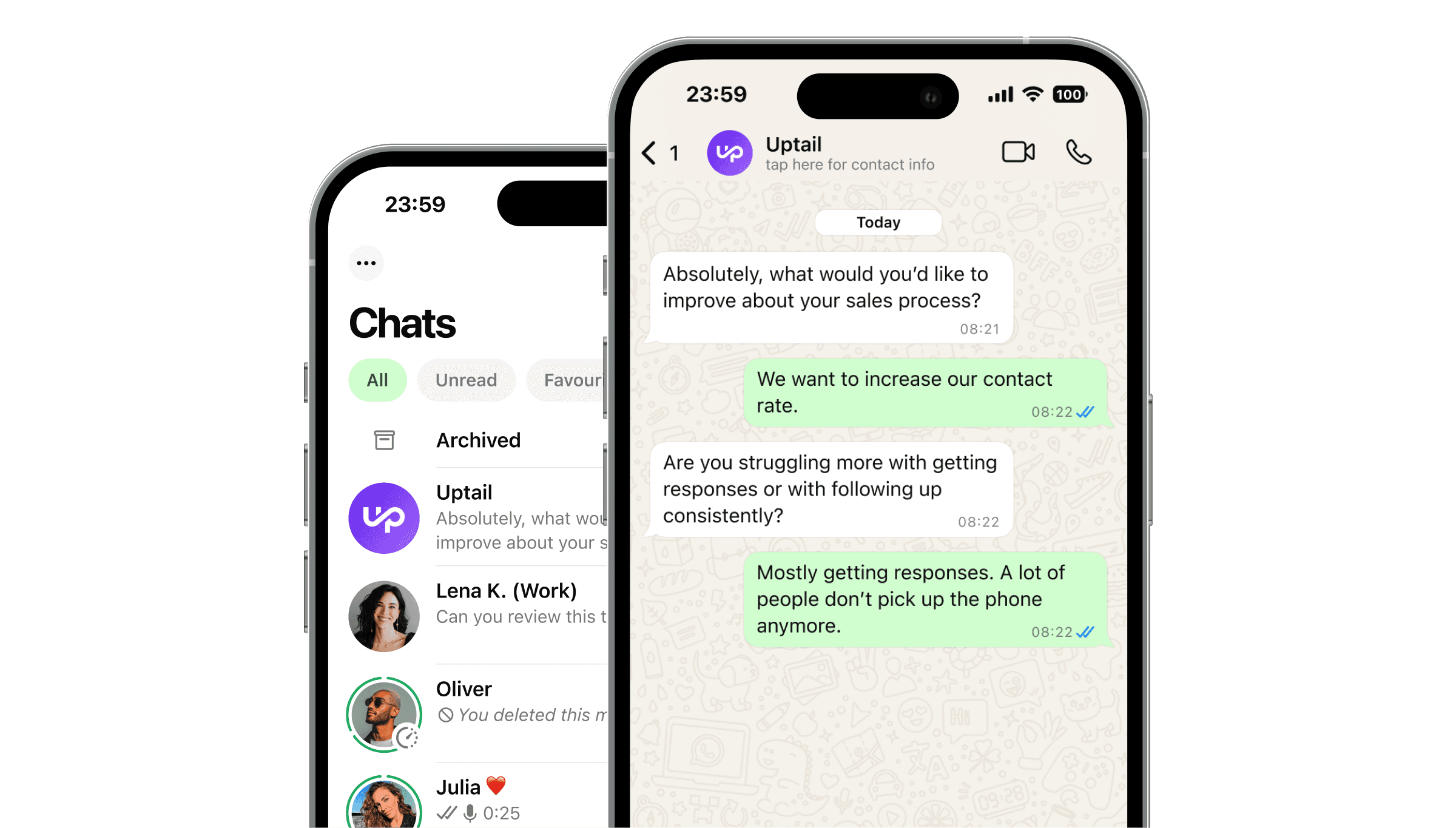
Not all WhatsApp chatbots work the same way. Some follow a fixed script, if the customer says X, the bot says Y. Others use AI to understand what the customer means and generate a relevant response, even if the exact wording wasn't anticipated. Both approaches run on the WhatsApp Business API.
Both can automate conversations. But they solve different problems, and choosing the wrong one creates friction instead of removing it.
This guide breaks down how each type works, where each one excels, and how to decide which approach, or which combination, fits your business.
Quick Answer
Rule-based WhatsApp chatbots follow predefined decision trees, fixed paths with buttons and keyword triggers. They're predictable, fast to build, and ideal for structured workflows like lead qualification, appointment booking, and FAQ routing. WhatsApp AI agents use natural language processing and large language models to understand free-text input and generate dynamic responses. They handle ambiguous questions, multi-turn conversations, and topics that weren't explicitly programmed. Most businesses in 2026 benefit from a hybrid approach: rule-based flows for structured processes, AI for open-ended conversations.
5 min: Responding to a lead within five minutes makes you 100× more likely to connect than waiting 30 minutes, according to Harvard Business Review. Whether your bot uses rules or AI, instant response is the baseline, the question is what happens next.
How Each Type Works
Feature | Rule-Based | AI agentsa |
|---|---|---|
How it responds | Follows a fixed decision tree with pre-written answers | Interprets intent and generates responses dynamically |
Input handling | Buttons, quick replies, exact keyword matches | Free-text messages, typos, slang, multiple languages |
Setup complexity | Low: visual flow builder, no training data needed | Medium to high: requires training, knowledge base, or LLM integration |
Predictability | High: the bot says exactly what you programmed | Lower: responses vary based on input and model behaviour |
Maintenance | Manual: new scenarios require new branches | Semi-automatic: model improves with data, but needs monitoring |
Best for | Structured processes: qualification, booking, routing, FAQs | Open-ended support, product discovery, complex Q&A |
Failure mode | Dead end: customer hits a path the bot doesn't cover | Hallucination: bot generates a confident but incorrect answer |
When Rule-Based Is the Right Choice
Rule-based chatbots are the right tool when the conversation follows a predictable path. If you can draw the flow on a whiteboard, with clear branches and defined endpoints, rules will handle it faster, cheaper, and more reliably than AI.
Lead Qualification
Ask 3–5 structured questions (company size, use case, timeline), score the answers, route by score. The path is linear, the inputs are constrained by button options, and the outcome is deterministic. Rules are perfect here.
Appointment Booking
Service selection → date/time from calendar → confirmation. Every step has a finite set of options. A rule-based flow handles this in seconds without any risk of misinterpretation.
Routing & Handoff
"Sales, support, or billing?" → route to the right team. Menu-driven routing is faster and more reliable with buttons than with free-text intent detection.
When AI Is the Right Choice
AI-powered chatbots earn their cost when conversations can't be anticipated. If customers ask questions in their own words, across a wide range of topics, and expect the bot to understand context, AI is the only approach that works.
Service discovery and recommendations
A customer describes what they need in natural language, "I'm looking for a course that costs less than x." An AI bot can interpret this, match it to your service catalogue, and suggest relevant courses. A rule-based bot would need a filter menu for every attribute.
Complex customer support
When the question isn't a standard FAQ, "I booked an appointment but I cant attend and I also want to ask about another course", AI can parse multiple issues in one message and generate a coherent response.
Multilingual conversations
AI models handle language switching natively. A customer who starts in English and switches to Spanish mid-conversation doesn't break the flow. Rule-based bots would need duplicate trees for every language.
Knowledge base Q&A
Feed your documentation, policies, or help centre into an AI bot and it can answer questions about any of it, without building a branch for every possible question. This is the use case where AI provides the biggest efficiency gain over rules.
The Hybrid Approach (What Most Teams Actually Need)
In practice, the choice isn't either/or. The most effective WhatsApp agents in 2026 combine both. A rule-based flow handles the structured parts - greeting, qualification questions, menu routing, appointment booking - and an AI agent activates when the conversation goes off-script or the customer types a free-text question.
This hybrid model gives you the predictability of rules where you want control and the flexibility of AI where you need it. The key is designing clear handoff points: the rule-based flow handles the path, and when a message doesn't match any expected input, the AI takes over, or the conversation routes to a human agent.
Frequently Asked Questions
Do I need an AI agent or is a rule-based chatbot enough?
It depends on how predictable your conversations are. If most customer interactions follow a clear path a rule-based bot handles that faster, cheaper, and more reliably. If customers ask open-ended questions in their own words across a range of topics, you need AI for those parts.
What happens when an AI chatbot doesn't know the answer?
AI chatbots can hallucinate, generating confident answers that are wrong. That's why every bot needs a clear path to a live agent as a fallback, and why reviewing conversation logs regularly is essential. Monitoring AI responses, flagging inaccuracies, and updating the knowledge base prevents repeat errors.
Should I build AI-first or start with rules?
Start with rule-based flows for your core use cases then layer AI on top to handle the gaps. Building AI-first without structured flows underneath leads to unpredictable behaviour and harder debugging.
Is an AI WhatsApp agent more expensive than a rule-based one?
Generally, yes. AI adds cost through LLM API calls, training, and ongoing monitoring. For structured, high-volume conversations like menu routing or appointment booking, a rule-based bot is more cost-effective. AI earns its cost when it handles conversations that would otherwise require a human agent.