Carlos Delgado
WhatsApp Business vs WhatsApp API: A Plain-English Comparison for 2026
Same platform, completely different capabilities. Here's how to decide which one your business actually needs and when it's time to upgrade.
Quick answer
The WhatsApp Business App is a free mobile app designed for small businesses. It works on a single device, supports basic automation like greeting messages and quick replies, and lets you broadcast to up to 256 contacts. Think of it as WhatsApp with a business profile attached.
The WhatsApp Business API (officially called the WhatsApp Business Platform) is a backend system built for scale. It has no interface of its own, you access it through a software provider. It supports unlimited agents, chatbot automation, CRM integrations, bulk messaging, and analytics. It's what companies use when the app stops being enough.
Two Products, One Platform
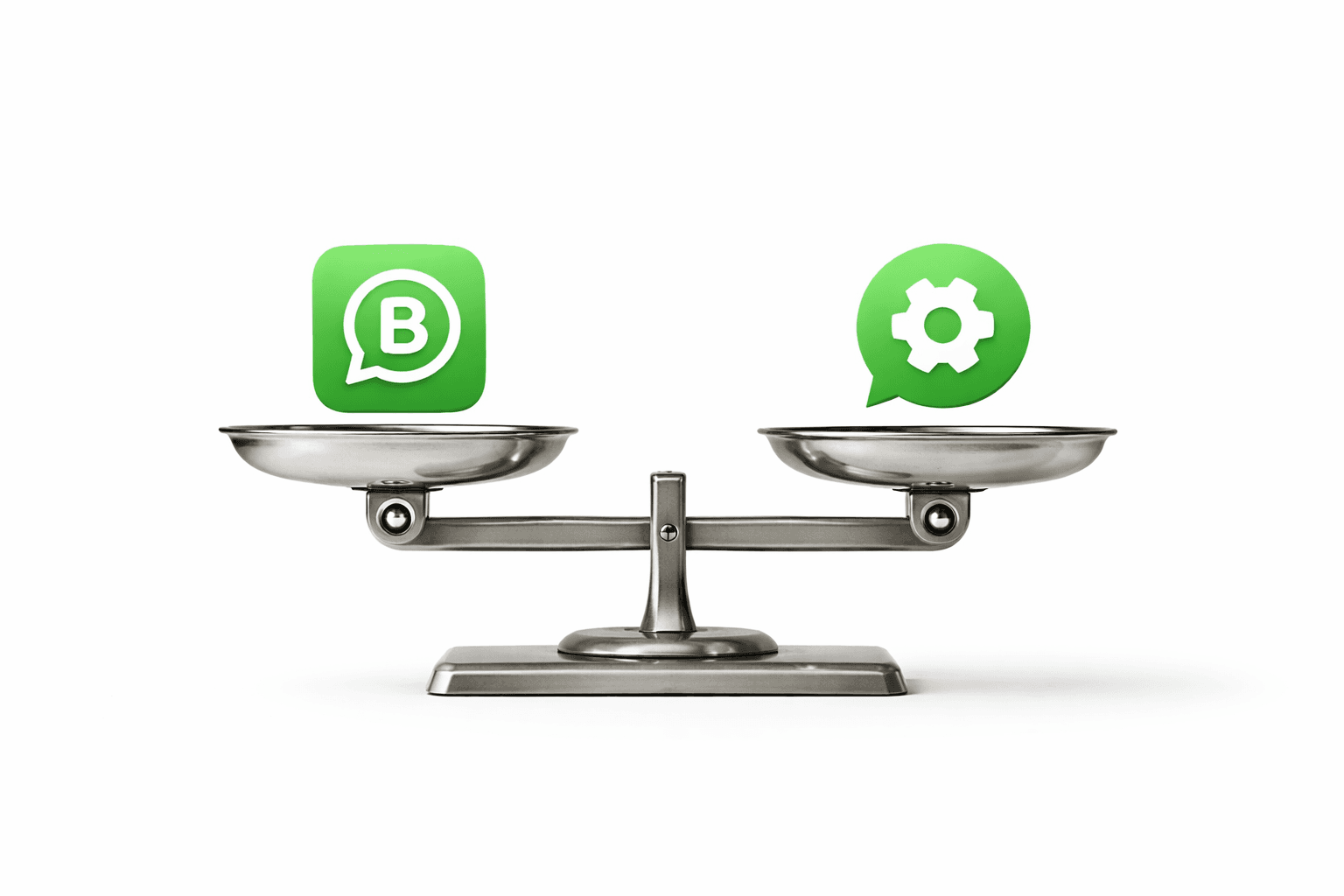
Meta offers two distinct products for businesses that want to communicate through WhatsApp. They share a name and a platform, but the similarities end there. The WhatsApp Business App is a standalone mobile application you download from the App Store or Google Play. The WhatsApp Business API is a programmatic interface with no front-end, it's infrastructure that developers and software platforms plug into.
The distinction matters because choosing the wrong one can either leave you overpaying for features you don't need, or struggling with limitations that cap your growth. Let's break down every meaningful difference.
Full Comparison
Feature | Business App | Business API |
|---|---|---|
Cost | Free | Per-message + BSP fee |
Setup | Download from app store, instant | Apply through a Business Solution Provider (BSP) |
Interface | Mobile app + web companion | No native UI, accessed via BSP dashboard |
Users / Agents | 1 phone + up to 4 linked devices | Unlimited agents on a shared inbox |
Automation | Greeting & away messages, quick replies | Chatbots, AI agents, workflows, conditional logic |
Broadcasts | Up to 256 contacts per list | Virtually unlimited with pre-approved templates |
CRM Integration | None | Full integration with CRMs, ERPs, helpdesks |
Analytics | Basic message stats | Delivery, read, click, and response tracking |
Verification Badge | Meta Verified (paid subscription) | Official Business Account (merit-based, free) |
Voice Calls | Supported natively | Available via Calling API (launched July 2025) |
WhatsApp Groups | Can join and create groups | Not supported |
Best For | Solo operators, micro-businesses | Growing companies, enterprise teams |
WhatsApp Flows
WhatsApp Flows, structured, in-chat experiences like forms, appointment pickers, surveys, and feedback collection, are only available through the API. Customers can fill out information, select options, and complete actions without ever leaving the chat. No external links, no redirecting to a browser. This capability alone can dramatically improve conversion rates for businesses that rely on customer data collection.
The Right Tool for Your Stage
This isn't about which product is "better", it's about which one matches your current operational reality. Here's how to think about it:
Solo operators and micro-businesses → Business App
You handle fewer than 20 customer messages a day. You're the only person replying. You don't need integrations or complex automation, just a professional profile and quick way to respond. The free app is perfect.
Growing companies with a support team → Business API
You're handling 50+ conversations daily. Multiple people need access to the same WhatsApp number. You want automated responses, CRM sync, and broadcast campaigns that go beyond 256 contacts. Time to move to the API.
Enterprise and e-commerce brands → Business API
You need AI-powered agents, multi-department routing, ticketing systems, order notifications, abandoned cart flows, and detailed analytics. The API isn't just recommended, it's the only option that scales with enterprise demands.
When to switch: The clearest signal is when the app starts holding you back. If multiple team members are replying from the same phone and dropping conversations, if you're hitting the 256-contact broadcast limit, or if you're manually copy-pasting responses that a chatbot could handle, it's time to migrate to the API.
You can convert an existing Business App number to an API number, but the process is one-way and irreversible.
Frequently Asked Questions
Can I use both at the same time?
Not on the same number. However, as of 2026, Meta supports coexistence ,you can keep the Business App running on your number while connecting the API through a BSP. Your app continues working normally while the API handles automation and team inbox features in parallel.
Can I switch from the app to the API?
Yes. You can convert your existing Business App number to an API number through a BSP. Be aware that historically, this was a one-way process that couldn't be reversed. With coexistence now available, you may have more flexibility, but check with your specific BSP.
Do I need a developer to use the API?
Not necessarily. While the API itself is a developer-facing backend, BSPs like Uptail, Wati, Respond.io, and others provide no-code dashboards that let non-technical teams send broadcasts, build chatbots, and manage conversations without writing any code.
Does the API support voice calls?
Yes, Meta launched the WhatsApp Business Calling API in July 2025. It allows businesses to make and receive voice calls programmatically through the API. This is useful for appointment confirmations, delivery coordination, and situations where a call resolves issues faster than text.
Is the green tick / blue tick available on the app?
Through the Meta Verified paid subscription, yes, Business App users in supported countries can now get the blue verification badge. The free Official Business Account (OBA) path, however, still requires the API and is reserved for notable brands that meet Meta's review criteria.