Carlos Delgado
Best WhatsApp AI Agent for Small Business 2026: How to Choose, Compare, and Set One Up

Quick Answer
The best WhatsApp AI agent for a small business is one that connects to the WhatsApp Business API, handles your specific use case (lead qualification, appointment booking, or customer support), integrates with your CRM and calendar, and can be deployed and managed without a dedicated technical team. For most small businesses, a managed solution, where the provider builds and optimises the agent for you, is faster and lower risk than a self-serve platform you configure yourself. The most important factors to compare: response quality, integration depth, human handoff capability, pricing model, and time to go live.
In 2026, every small business owner has heard they should be using AI on WhatsApp. Fewer have a clear picture of what the options actually are, what separates a good agent from a poor one, or how to make a decision without spending six months evaluating platforms.
This blog covers what a WhatsApp AI agent actually does for a small business, how to compare the main types of solutions, and the setup steps that determine whether your agent converts leads or just responds to them.
What a WhatsApp AI Agent Does for a Small Business
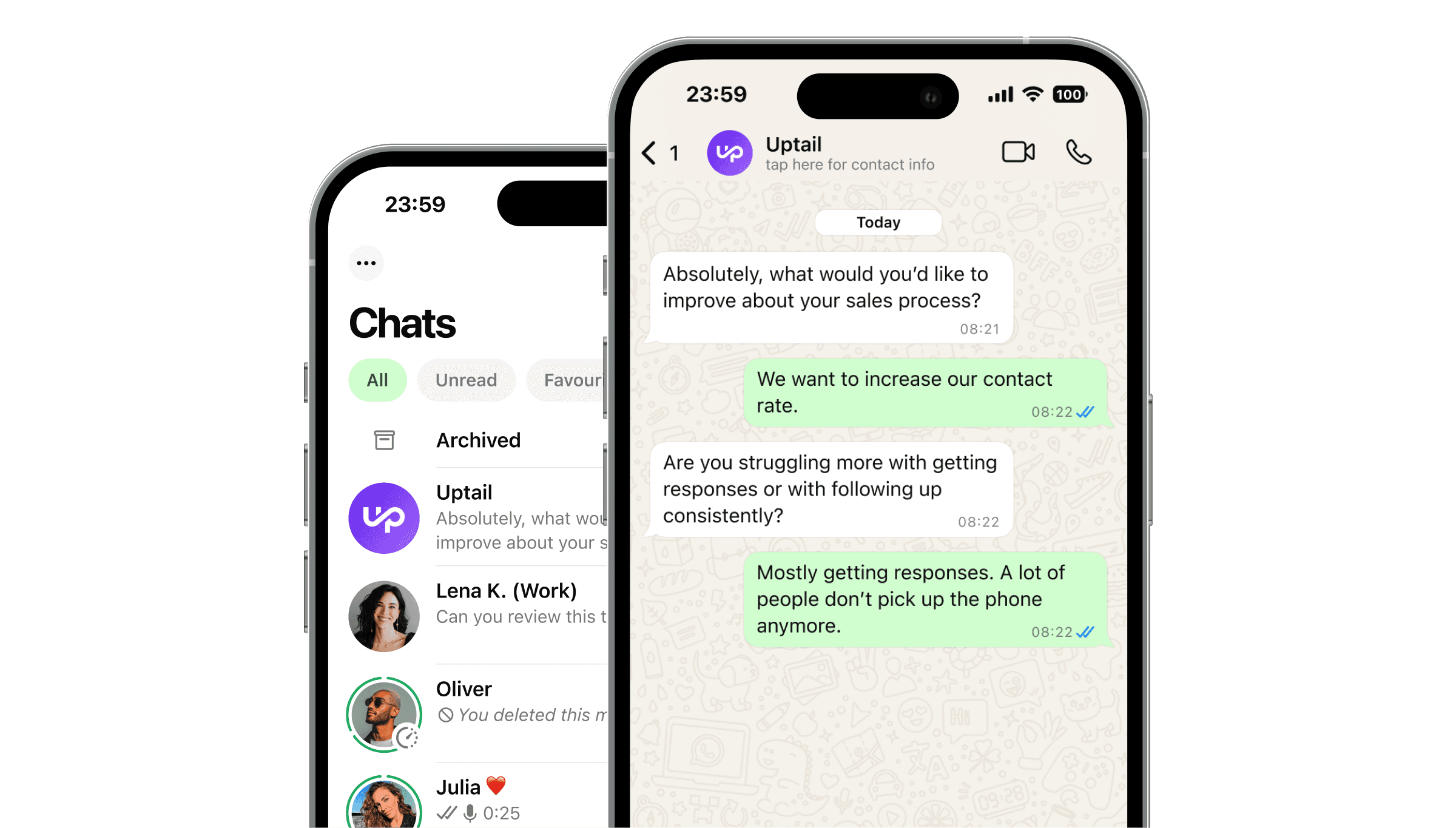
A WhatsApp AI agent is software connected to the WhatsApp Business API that handles customer conversations automatically, responding to enquiries, qualifying leads, booking appointments, answering common questions, and escalating to a human when judgment is required.
For a small business, this typically means:
Responding to inbound enquiries instantly, regardless of when they arrive, including evenings, weekends, and bank holidays
Qualifying leads with 2–3 questions to identify serious prospects before passing them to a human
Booking appointments directly inside the WhatsApp conversation, no separate form, no callback required
Answering common questions about pricing, availability, services, and location
Following up automatically with leads who didn't respond to the first message
Escalating to a human with the full conversation context already attached
The commercial case is straightforward: research shows firms contacting leads within five minutes are 100x more likely to make contact than those waiting 30 minutes (InsideSales Lead Response Management Study).
A small business owner cannot personally respond to every inbound message within 60 seconds. An AI agent can.
The 3 Types of Solution
Type | Who Builds It | Best For | Trade-Off |
|---|---|---|---|
Managed solution | Provider builds and optimises for you | Businesses without technical staff; sales and lead gen use cases; fastest to launch | Higher cost; less direct control over configuration |
Self-serve no-code builder | You build it using a visual flow editor | Tech-comfortable owners; simple, predictable use cases; full control preferred | Requires significant time investment to build, test, and maintain |
AI-enhanced inbox | Team uses a shared inbox with AI suggestions | Businesses not ready for full automation; teams managing conversations manually | Humans remain in the loop; doesn't solve the after-hours problem |
6 Things to Evaluate Before You Choose
1. Ease of API access
The WhatsApp Business API is required for any AI agent. A good managed provider handles Business Verification, number setup, and Meta compliance for you. Self-serve platforms vary, some include API access, others require you to obtain it independently. Confirm before committing.
2. Response quality on off-script messages
Ask the provider to demo the agent with the awkward messages your customers actually send, complaints, ambiguous requests, multi-part questions. A good agent handles these gracefully. A poor one returns generic fallback responses or breaks entirely.
3. Human handoff with context
When the agent escalates to a human, the full conversation history should be visible in the same thread. No context lost, no customer asked to repeat themselves. This is table stakes, confirm it works before signing.
4. CRM and calendar integration
Lead data from WhatsApp conversations should flow into your CRM automatically. Appointment bookings should create calendar entries in real time. Ask specifically which CRMs and calendars are supported and whether the integration is native or via Zapier (native is more reliable).
5. Pricing model
Flat monthly subscription gives predictable costs but doesn't tie payment to results. Pay-per-performance (per qualified lead or booked appointment) means your cost is always tied to an outcome, lower risk for small businesses with uncertain volume. Compare both against your expected conversion rate.
6. Time to go live
Managed solutions typically deploy in 3–6 weeks. Self-serve platforms can go live faster but often require more iteration post-launch. Ask for a realistic timeline and what's required from you during onboarding.
Step by Step Setup Guide
Step 1: Define your use case precisely
The most common small business use cases are: qualifying new leads and booking sales calls; scheduling appointments for service businesses; and handling customer support for e-commerce or local businesses. Your use case determines which configuration and platform type is right.
Step 2: Collect your business information
The agent needs to know what you offer, your pricing (or how to handle pricing questions), your booking process, your location and hours, and the questions customers most commonly ask. Gather this before onboarding, the clearer your inputs, the better the agent performs from day one.
Step 3: Get WhatsApp Business API access
If using a managed provider, they handle this. If self-serve, you'll access the API through a Meta-approved Business Solution Provider (BSP). Business Verification is required, have your legal business documents ready.
Step 4: Connect your CRM and calendar
Minimum viable integrations: lead data flows into your CRM automatically; bookings create calendar entries in real time. If you're not using a CRM, HubSpot's free tier works well for most small businesses at this stage.
Step 5: Define escalation triggers
Which situations always go to a human? Common ones: pricing negotiations, complaints, questions requiring judgment your agent can't pre-programme. Set these as explicit triggers in the agent configuration.
Step 6: Test before going live
Send the agent every type of message your customers send — including unusual ones, voice notes, ambiguous questions, and direct requests to speak to a human. Fix every gap before launch.
Step 7: Review weekly in the first month
After launch, review conversations weekly. Look for recurring questions the agent handles poorly, escalation triggers firing too often, and drop-off points in the qualification flow. Most agents improve significantly in the first 30 days with small adjustments.
Use Cases by Industry
Education and training
Language schools, tutoring services, and training providers use agents to handle enrolment enquiries, answer questions about courses and fees, and book intake appointments. The agent qualifies prospective students and routes serious enquiries to the right person.
Beauty and wellness (salons, clinics, spas)
Agents handle booking, reminders, rescheduling, and post-appointment follow-ups, entirely inside WhatsApp. Customers don't need to call or navigate a separate booking page.
Real estate (independent agents and small agencies)
Agents qualify inbound enquiries from property listings, book viewings, and answer common property questions. High enquiry volume is handled at scale; the agent focuses human time on near-transaction conversations.
B2C sales
Instead of email back-and-forth to schedule a demo, a WhatsApp flow presents available slots and books instantly. The rep receives a notification with lead context already captured.
Frequently Asked Questions
Do I need to change my WhatsApp number?
No. The AI agent connects to your existing WhatsApp Business number. Customers message the same number they already have.
Will customers know they're talking to an AI?
This depends on how you configure the agent. Best practice is to disclose when the customer asks directly or when the conversation escalates to a human. Many businesses give the agent a name and persona that matches their brand without proactively disclosing automation.
What if I only get a few messages a day?
WhatsApp AI agents are valuable even at low volume because the value is speed, not scale. A lead who messages at 9pm on a Sunday and gets a response within 60 seconds converts at a much higher rate than one who waits until Monday. At low volume, a pay-per-performance model ensures you only pay when outcomes are delivered.
Can I take over conversations manually when I want to?
Yes. All platforms include a way to take over a conversation manually, pause the agent for that thread, and resume automation afterwards. You remain in full control.
What's a realistic ROI expectation?
For lead qualification and call booking use cases, most businesses see a meaningful improvement in lead-to-meeting conversion rate within the first 30 days, primarily driven by faster first response. The exact ROI depends on your average deal value and current response time. Businesses with a 2–4 hour average response time typically see the most dramatic early impact.