Carlos Delgado
How to Qualify Leads on WhatsApp: A Practical Guide for Sales Teams

How to Automate Lead Qualification on WhatsApp
Getting leads into WhatsApp is the easy part. The hard part is knowing which ones are worth your reps' time. Without a qualification process, every inbound message gets the same attention, and your team burns hours chasing people who were never going to buy.
Lead qualification on WhatsApp works differently from phone or email. The conversation is real-time, the response expectations are high, and the window to capture intent is short.
The good news: it can be almost entirely automated.
Quick Answer
To qualify leads on WhatsApp, set up an automated conversation flow that asks 3–5 key questions (company size, use case, timeline, budget), assigns a lead score based on the answers, and routes high-intent leads to a sales rep instantly, with full context. This runs on the WhatsApp Business API and can be live in under a day with the right platform.
Responding to a lead within 5 minutes makes you 100× more likely to connect, according to research published by Harvard Business Review. WhatsApp automation makes sub-5-second response times standard.
What Makes a Qualified WhatsApp Lead
Before building a flow, define what "qualified" means for your team. Most B2C sales teams look for picking up intent, readiness, and fit directly from the conversation.
The goal is to capture enough information in 3–5 questions to score intent, without making the conversation feel like a survey.
Criteria | What to Ask | Why It Matters |
|---|---|---|
Need | “What are you looking to book today?” | Filters out curiosity browsers from real buyers |
Urgency | “Are you looking to book ASAP or just exploring?” | Prioritizes high-intent users |
Timeline | "When are you looking to start?" | Separates active buyers from future researchers |
Location / Branch | “Which location works best for you?” | Prevents drop-off later in the booking flow |
Availability | “What day/time works for you?” | Moves directly toward scheduling |
You don't need all five in every flow. Pick the 3–4 that your sales team actually uses to decide whether to book a call. More questions means more drop-off.
How to Build the Qualification Flow
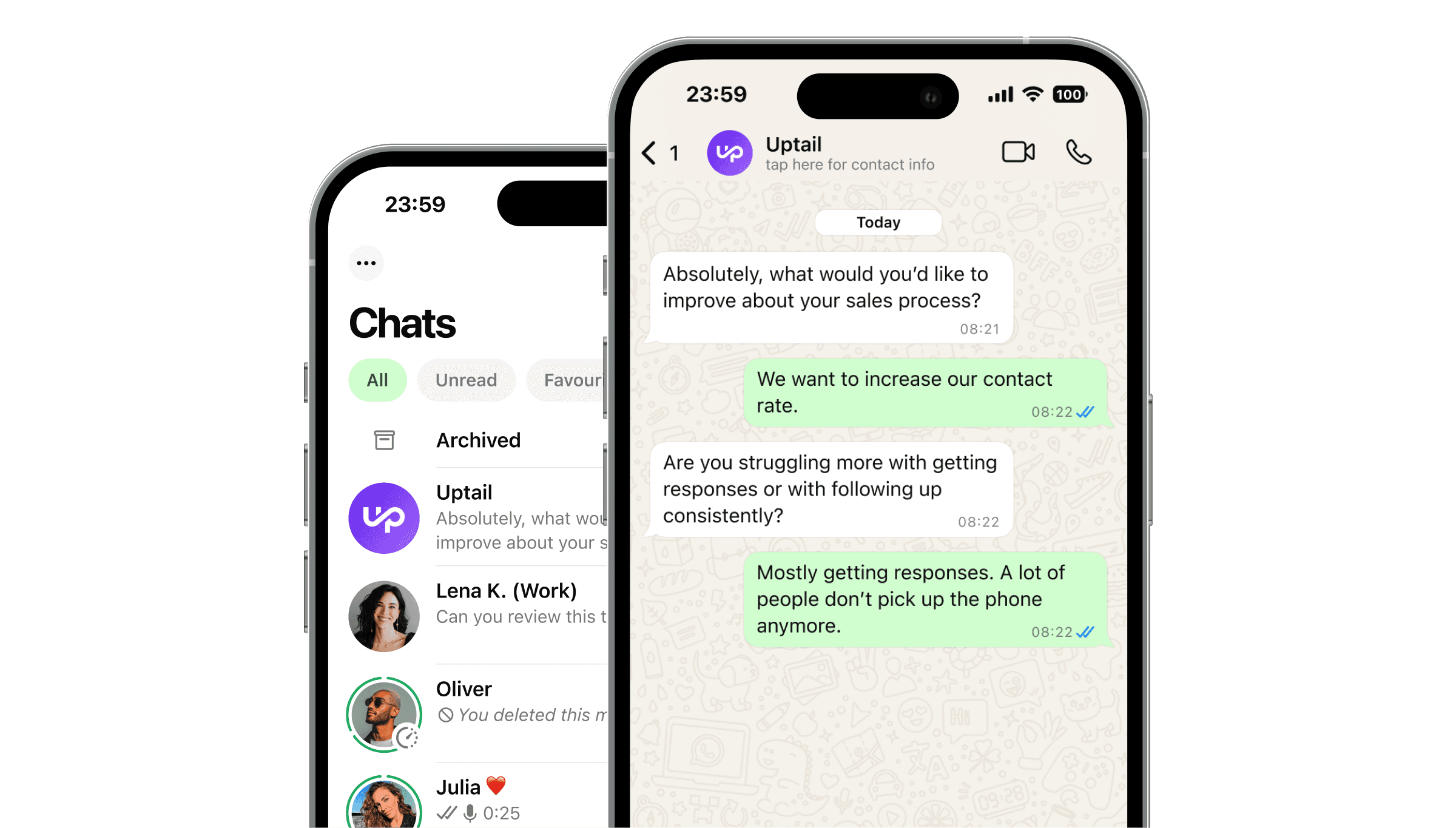
Welcome message: Acknowledge the lead instantly, within seconds not minutes. State who you are, confirm what they're interested in, and set the expectation: "I'll ask a few quick questions to connect you with the right person."
Ask qualifying questions: Send one question at a time. Use button replies or numbered options where possible, they reduce friction and make scoring easier. Keep the tone conversational, not transactional.
Score the answers: Map each response to a point value. For example: team size over 50 = +3, timeline under 30 days = +3, no budget defined = +0. A total above your threshold means "sales-ready."
Route by score: High-score leads go directly to a rep with full conversation context attached. Medium-score leads enter a nurture drip. Low-score leads get a self-serve resource link and stay in the database for future re-engagement.
Sync to CRM: Every answer, score, and routing decision pushes to your CRM automatically. The rep sees the full picture before they pick up the conversation, no repeat questions, no context gaps.
4 Qualification Patterns That Work
Inbound from Ads
Lead clicks a click-to-WhatsApp ad. Automation greets, asks 3 questions, scores, and books a meeting, all before a rep is involved. Best for high-volume paid acquisition.
Website Widget
Visitor starts a WhatsApp chat from the site. The flow identifies their interest based on the page they came from and asks targeted questions. Higher quality than a generic form.
Event Follow-Up
QR code at a booth opens a WhatsApp conversation. The flow qualifies on the spot, no business card pile to sort through the next week.
Referral Intake
A shared link triggers a qualification flow tailored to referrals. Shorter sequence (2–3 questions) because the trust bar is already cleared.
Mistakes That Kill Qualification Rates
Asking too many questions
More than 5 questions and completion rates drop sharply. Prioritise the data your reps actually need to decide whether to call.
Slow first response
If the welcome message takes more than a few seconds, the lead has already moved on. Automation should fire instantly on opt-in.
No branching logic
Sending the same flow to every lead regardless of their answers wastes time and feels robotic. Branch based on responses.
Skipping CRM sync
If qualification data doesn't land in your pipeline, reps ask the same questions again on the call, and the lead loses patience.
Never following up on medium-score leads
Not every lead is ready today. A nurture sequence that re-engages in 7–14 days recovers leads that would otherwise go cold.
Lead qualification on WhatsApp works because the channel is fast, personal, and two-way.
The leads who reply are already showing intent. The job of the qualification flow is to measure that intent, score it, and get the right leads to the right rep, before the moment passes.