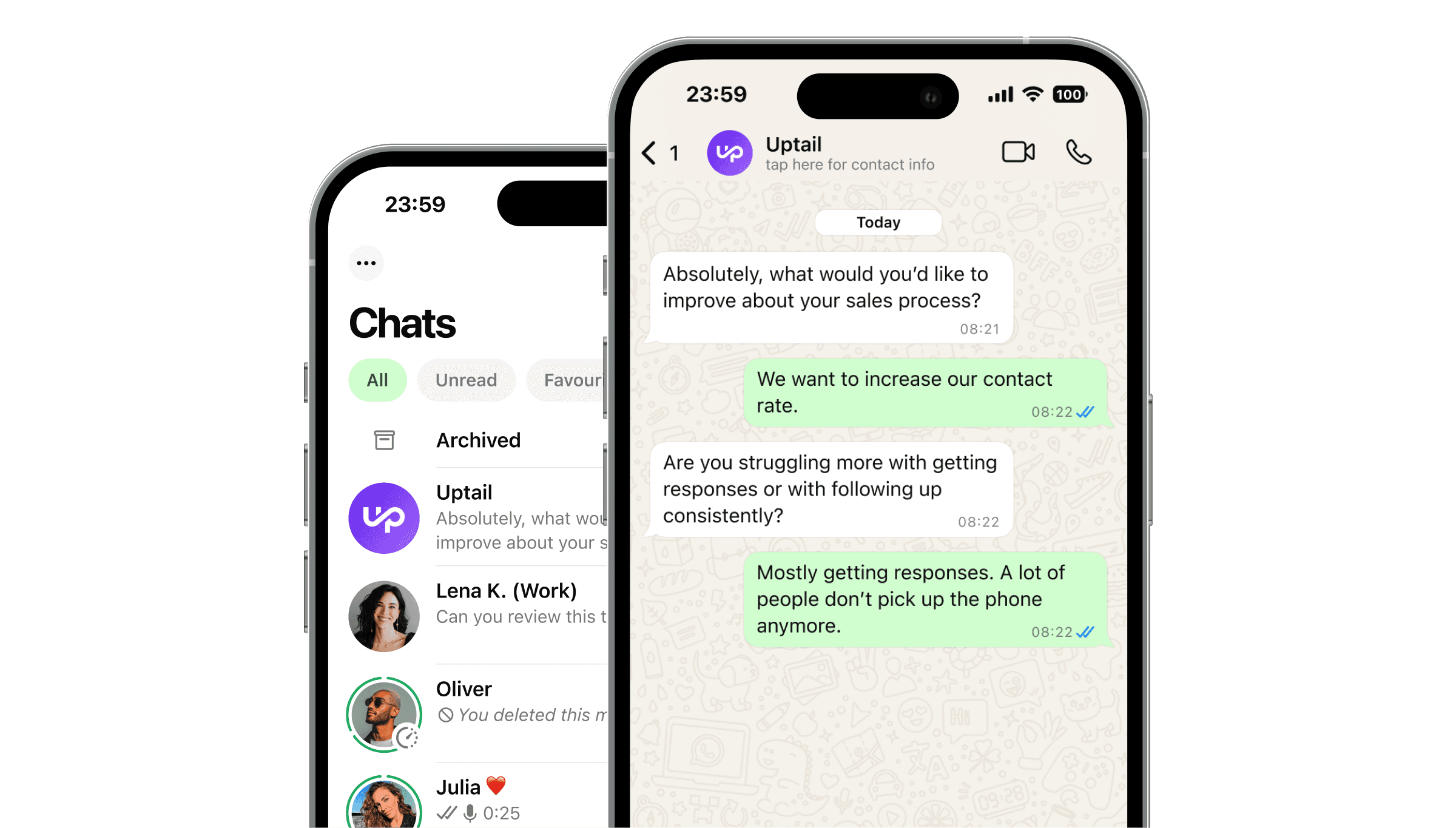
Carlos Delgado
HubSpot WhatsApp Integration: How to Connect, What You Get, and Where the Gaps Are
How to Connect WhatsApp to HubSpot (and What the Native Integration Misses)
HubSpot is one of the most widely used CRMs in the world. WhatsApp is the most widely used messaging app, with over 3 billion monthly users as confirmed by Meta CEO Mark Zuckerberg in 2025.
Connecting the two means your sales team can have WhatsApp conversations without losing CRM context, and every message, reply, and lead signal lands in the contact record automatically.
But the integration isn't as plug-and-play as it sounds. HubSpot offers a native WhatsApp connection, but it comes with limitations.
This guide explains every option, what each one gives you, and how to decide which approach fits your workflow.
Quick Answer
HubSpot offers a native WhatsApp integration through its Conversations Inbox, available on Marketing Hub and Service Hub Professional plans and above. It connects via the WhatsApp Business API and lets you send and receive messages inside HubSpot, log conversations to contact records, and use WhatsApp as a channel in workflows. However, the native integration has limitations: no visual chatbot builder, limited broadcast capabilities, and basic automation. For teams that need lead qualification flows, drip campaigns, or advanced routing, third-party WhatsApp platforms that sync with HubSpot via native connectors or Zapier provide a more complete solution.
24 hr service window: the WhatsApp Business API allows free-form replies only within 24 hours of the customer's last message (per Meta documentation). Outside that window, you need an approved template. Your integration must handle both modes.
3 Ways to Connect WhatsApp and HubSpot
Method | What You Get | Limitations | Best For |
|---|---|---|---|
HubSpot Native Integration | Send/receive in Conversations Inbox, log to contact timeline, basic workflow triggers | No visual bot builder, limited broadcast, requires Professional plan+ | Teams already on HubSpot Pro who need basic WhatsApp messaging |
Third-Party Platform with Native HubSpot Connector | Full WhatsApp automation (chatbots, drips, broadcasts) with bi-directional CRM sync | Additional platform cost, two dashboards to manage | Sales teams that need advanced flows, qualification, and routing |
Zapier / Make Middleware | Flexible data routing between any WhatsApp API tool and HubSpot | No real-time conversation view, requires setup and maintenance, per-task pricing | Custom workflows where native connectors aren't available |
Setting Up the Native HubSpot Integration
Verify requirements:
You need a HubSpot Marketing Hub or Service Hub Professional plan (or higher), a Meta Business account, and a phone number registered for the WhatsApp Business API. The number cannot already be connected to the WhatsApp Business App, it must be dedicated to the API.
Connect in HubSpot settings:
Go to Settings → Inbox → Channels → Connect a channel → WhatsApp.
Follow the prompts to link your Meta Business account and verify your phone number. HubSpot will provision the API connection through its Meta partnership.
Configure the inbox
Assign team members to the WhatsApp channel in the Conversations Inbox. Set routing rules so incoming messages go to the right rep or queue. Enable automatic contact creation for new inbound numbers.
Build workflow triggers
Use HubSpot Workflows to trigger actions based on WhatsApp events, for example, send a follow-up email if a WhatsApp conversation hasn't been replied to in 2 hours, or update a deal stage when a rep marks a conversation as qualified.
Submit message templates
For outbound messages outside the 24-hour service window, create and submit templates for Meta approval directly from HubSpot. Include personalisation tokens (contact name, company) and an opt-out instruction.
Where the Native Integration Falls Short
No Visual Chatbot Builder
HubSpot's native integration doesn't include a drag-and-drop flow builder for WhatsApp. You can set up basic auto-replies and workflows, but building multi-step qualification sequences or branching conversations requires a separate tool.
Limited Broadcast Tools
Sending bulk WhatsApp campaigns to segmented lists isn't well supported natively. HubSpot treats WhatsApp primarily as a 1:1 conversation channel, not a broadcast marketing tool. For campaigns at scale, a dedicated platform handles this better.
Basic Automation Only
Workflow triggers exist, but the WhatsApp-specific automation is limited compared to what dedicated platforms offer, no lead scoring inside the chat, no drip sequences triggered by message replies, no conditional routing based on conversation data.
Plan Restrictions
The integration is only available on Professional and Enterprise plans. Teams on HubSpot Starter or Free don't have access to the native WhatsApp channel, which pushes them toward third-party solutions regardless.
What to Sync Between WhatsApp and HubSpot
The value of the integration depends on what data moves between the two systems. At minimum, sync these five things:
Contact creation (new WhatsApp conversations should create or match HubSpot contacts)
Conversation logs (every message should appear on the contact timeline)
Lead source attribution (tag contacts acquired via WhatsApp so you can measure channel performance)
Deal stage updates (when a WhatsApp conversation results in a qualified lead, the deal should reflect that)
Opt-in status (track WhatsApp consent as a contact property so your marketing team knows who they can message)
Common Mistakes
Using the wrong number type: The WhatsApp Business API requires a dedicated number not already linked to the WhatsApp Business App. Trying to connect an existing Business App number will fail during setup.
Ignoring the 24-hour window: HubSpot reps sometimes try to reply to old conversations with free-form messages. After 24 hours, only approved templates work. Train the team on this or use automation to re-engage with a template first.
Not logging opt-in status: If you can't prove when and how a contact opted in, you're exposed to compliance risk. Store opt-in source, date, and method as HubSpot contact properties.
Relying on native integration for everything: HubSpot's native WhatsApp support is solid for basic messaging but limited for automation-heavy workflows. If you need chatbot flows, drip sequences, or broadcast campaigns, pair it with a dedicated WhatsApp platform.
Skipping the data mapping: Before going live, map every field: which WhatsApp data writes to which HubSpot property, which events trigger which workflows, and how duplicates are handled. Sloppy mapping creates messy CRM data fast.
The HubSpot WhatsApp integration works well for teams that need a basic conversation channel inside their CRM.
For teams that need full WhatsApp automation, chatbot flows, lead scoring, broadcast campaigns, drip sequences, the best approach is pairing HubSpot with a dedicated WhatsApp platform that keeps both systems in sync.