Carlos Delgado
The Admissions Follow-Up Sequence That Turns Passive Inquiries Into Campus Visits
Quick Answer
Most follow-up sequences fail because they ask for commitment too early and send too many messages too quickly. A four-stage sequence, first contact, qualification, warming, and visit invite, paced over seven to ten days, with genuine value at each step, consistently produces more campus visits than aggressive outreach.
Most admissions teams treat follow-up as a numbers game: send enough messages, and some percentage will convert. That logic produces sequences that feel like spam — five messages in three days, each one nudging harder than the last. Prospective students recognise the pattern immediately and disengage.
The sequences that actually produce campus visits operate on a different principle. They treat the follow-up window as a relationship-building period. Each message earns the right to the next by providing something useful before asking for anything. The result is a student who arrives at the visit invite already warm, already informed, and already inclined to say yes.
Why Most Admissions Follow-Up Sequences Fail
Three patterns account for the majority of failed sequences.
Asking for commitment too early
A campus visit is a significant investment of time, often involving travel and scheduling changes. Asking for it in message one, or even message two, puts the student in the position of either committing prematurely or going silent. Most go silent.
Message frequency that creates pressure
Sending three messages in 48 hours signals desperation, not genuine interest. It eliminates the natural pacing that allows a prospective student to process information and develop curiosity, and curiosity is what drives campus visits.
No value exchange
When every message is a variant of "have you thought about applying?" or "we'd love to have you visit," the student has no reason to engage. There is nothing to respond to except a request.
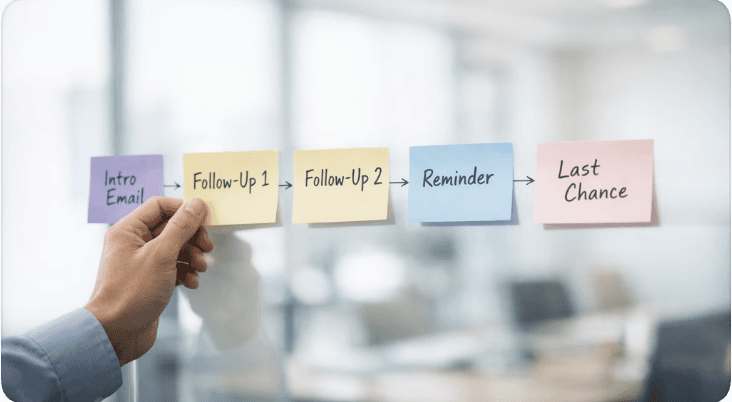
The Four Stages from Inquiry to Visit
Stage | Timing | Purpose |
|---|---|---|
First contact | Within 5 minutes | Acknowledge the specific inquiry + one qualifying question |
Qualification | Day 1–2 | Learn their timeline, motivation, or programme fit |
Warming | Days 2–5 | Deliver genuine value before asking for anything |
Visit invite | Day 7–8 | Specific, low-commitment ask with a named date and person |
This pacing mirrors the natural decision-making process for a significant commitment. It respects the student's timeline while keeping the institution present and relevant throughout.
Message 1: Speed and Programme Specificity
The first message should arrive within five minutes of the inquiry, this is when the prospective student's interest is at its peak.
That message needs to do two things: confirm you received their specific enquiry (not a generic "thanks for getting in touch"), and ask one qualifying question. Reference the programme they enquired about by name. Ask about their timeline for starting, whether they are working in the field, or what drew them to that programme. One question only.
Length matters. Under 150 characters is the practical target for WhatsApp. The goal is a reply, not a comprehensive information transfer.
Messages 2 and 3: Value Before You Ask Anything
Messages two and three, sent on days two and four, follow the same rule: give before you ask. Each should lead with something genuinely useful, tailored to what you learned from the qualifying question or the programme they enquired about.
Useful content at this stage includes:
A faculty profile relevant to their stated interests
A specific graduate outcome or employment statistic for the programme
A scholarship or funding opportunity they may not have known about
A short student story that reflects a situation similar to theirs
If there is no reply after message two, send message three anyway. Silence is not the same as disinterest. Some students read every message and are simply not yet ready to respond.
The Visit Invite: Make It Easy to Say Yes
The visit invite arrives at day seven or eight. By this point, the student has received genuine value from your institution and has formed a picture of what studying there would be like.
The invite should be specific and low-commitment. Name a date. Name a person they will meet. Describe what the visit involves in concrete terms.
"Would next Thursday work for a short visit? You'd meet [name], our programme coordinator, and get to see the campus."
This is more effective than an open-ended "come see what we have to offer." It gives the student a clear yes or no decision, not an open-ended commitment.
What to Do When There Is No Reply
Each stage warrants one follow-up attempt before moving on. If there is no reply to the first contact, send one brief check-in within 24 hours. If qualification goes unanswered, continue the warming sequence anyway. If the visit invite receives no response, send one final message one week later with an alternative date or a virtual option.
After that, move the contact to a long-nurture sequence. Some prospective students re-engage months later when their circumstances change.
Frequently Asked Questions
How many messages should I send before giving up on a lead?
Seven to nine messages over ten to fourteen days is a reasonable ceiling for active follow-up. Beyond that, continued outreach erodes rather than builds the relationship. Moving unanswered contacts to a low-frequency nurture sequence — monthly, value-driven — keeps the door open without burning goodwill.
What counts as "value" in a follow-up message?
Value is anything that helps the prospective student make a better-informed decision: employment statistics for programme graduates, scholarship deadlines they might miss, profiles of relevant faculty, or honest accounts of the student experience. Generic promotional content — "we're a leading institution" — does not qualify.
Should I call instead of message?
Calling without a prior agreement is increasingly likely to be ignored, particularly by younger prospective students. A better approach is to ask in message one whether a call would be welcome, or to offer it as an option in the visit invite. When the student initiates or agrees to a call, conversion rates improve significantly.
What if the student replies but doesn't agree to a visit?
A reply without a commitment is still a positive signal. Respond to what they said, not to the absence of a yes. Ask a follow-up question, provide another piece of relevant value, and revisit the visit invite naturally. The goal is to keep the conversation going, not to force a decision.
How do I personalise follow-ups at scale without manually writing each message?
Template personalisation using the programme name, the qualifying question answer, and any volunteered details works well for the core structure. AI-assisted messaging tools can pull programme-specific data points and insert them contextually. The key is that personalisation should feel specific — if the student can tell a variable was swapped in, it loses its effect.