Carlos Delgado
WhatsApp vs Live Chat: Which One Should You Put on Your Website?
Quick Answer
Live chat wins for immediate, in-session support during a purchase or onboarding flow. WhatsApp wins when your sales cycle is long, your audience is mobile-first, or your product requires ongoing trust-building. If your conversation needs to survive after the tab closes, WhatsApp is the right tool.
Every website eventually reaches the same decision point: a visitor has a question, and you want to help them answer it before they leave. The widget in the corner of the screen is your attempt to intercept that moment. But live chat and WhatsApp are built on fundamentally different assumptions about how conversations happen, and choosing the wrong one is not a minor UX detail. It shapes how many leads you capture, how many conversations you complete, and how many deals you close.
Both channels look similar on the surface: a floating button, a conversation window, a back-and-forth exchange. But underneath the interface, they operate on opposing logics. Understanding that difference is the only reliable way to make the right call for your specific business.
What Each Channel Is Actually Built For
Live chat is a synchronous tool. It assumes that the visitor and the support agent are present at the same time, in the same session, working toward a resolution before the conversation ends. It is the digital equivalent of a shop floor assistant: immediate, transactional, and bounded by the visit itself.
WhatsApp is an asynchronous tool. It assumes that conversations will be picked up and put down across time, across devices, and across days. It is designed for ongoing relationships, not single-session resolutions. A WhatsApp thread does not have an end state the way a live chat session does, it simply continues.
The right question is not which has better features. It is: does my customer's decision happen in one session, or does it unfold over time?
Where Live Chat Wins
Live chat earns its place in three specific scenarios. The first is immediate transactional support, the kind that e-commerce businesses rely on. When a customer is on the checkout page, confused about a shipping cost or a discount code, they need an answer in thirty seconds or they will abandon the cart. There is no friction of switching apps, no need to exchange phone numbers, no asynchronous gap.
The second scenario is SaaS onboarding. When a new user hits a configuration screen they do not understand, an in-app live chat widget allows a support agent to intervene before the user churns.
The third is any context where anonymity is preferable. Live chat does not require the visitor to share a personal phone number. For certain industries or sensitive topics, that lower barrier to entry matters.
Where WhatsApp Wins
WhatsApp has a structural advantage in high-consideration categories: higher education, private healthcare, real estate, financial products, premium B2C services. These are purchases where the decision cycle spans weeks or months and where trust is built incrementally through a series of conversations.
In these contexts, live chat is almost always the wrong tool. The visitor who asks a question about a postgraduate programme today will not make a decision for another three weeks. When they close that browser tab, the live chat session ends and the lead goes cold. WhatsApp does not have this problem. The conversation thread remains accessible on their phone, in the same app they use to talk to people they trust.
WhatsApp also wins decisively with mobile-first audiences. Live chat widgets are frequently unusable on small screens. WhatsApp is the native communication environment for mobile users, sending them there is meeting them where they already are.
The Tab-Close Problem
When a website visitor closes their browser tab, the live chat session ends. The conversation history may exist in your CRM, but there is no thread on the visitor's side. Any follow-up from your team arrives as a new message in a new context, usually by email, usually much later, usually with diminished relevance.
This is not a minor inconvenience. It is a structural feature of how live chat works. For businesses where the decision moment extends beyond a single visit, live chat hands the lead a reason to go cold every time the session ends.
The Continuity Advantage of WhatsApp
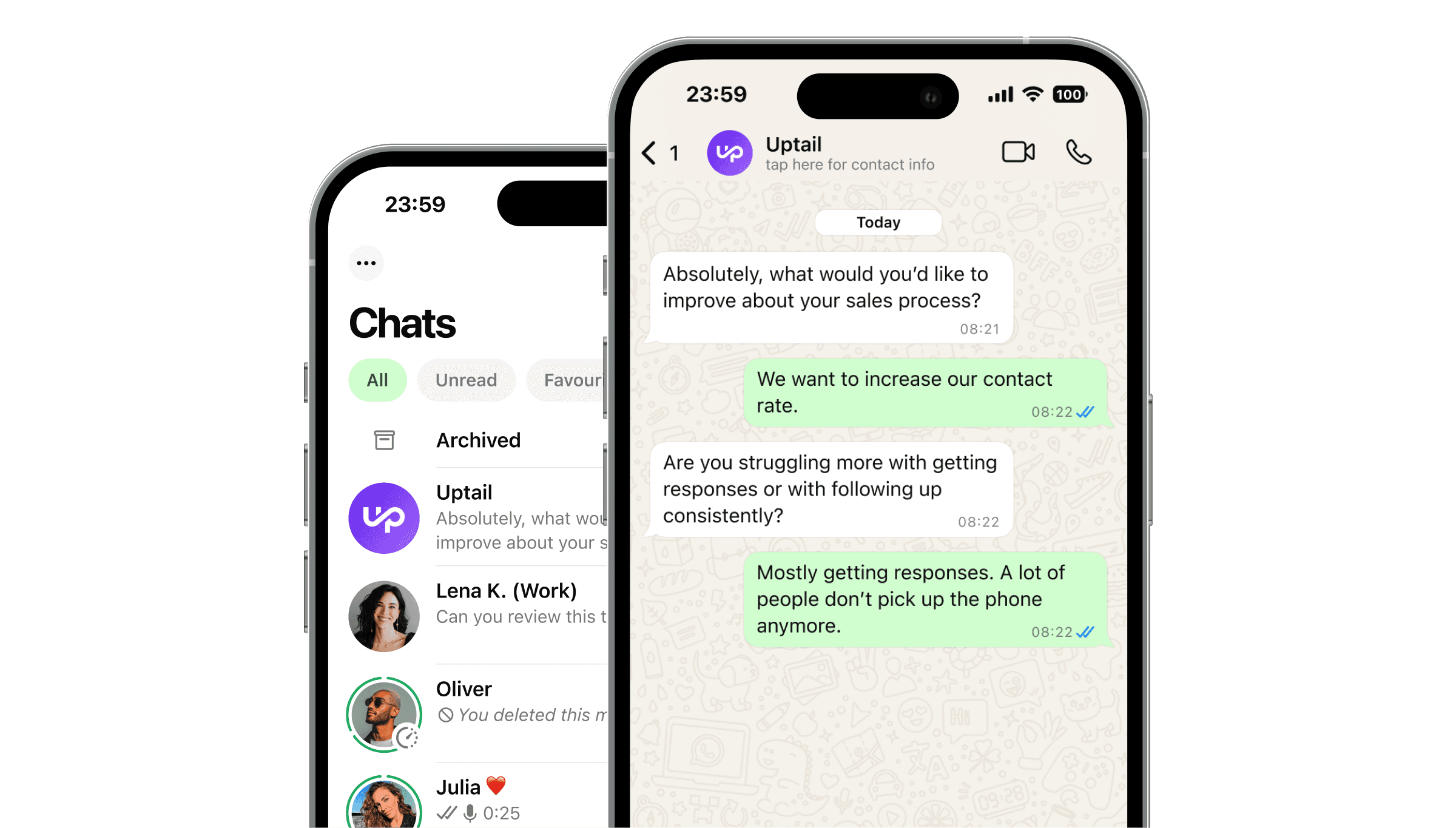
WhatsApp conversations have no natural expiry. A thread started when a prospect first made contact can continue through their research phase, their comparison stage, their negotiation, and their post-purchase questions, all in a single, unbroken history.
This continuity has a practical value that is easy to overlook. When a prospect picks up a conversation three days after their last message, they can scroll up and see exactly what was discussed. There is no re-establishing of context, no starting from scratch. The conversation is already warm.
This is also what makes WhatsApp well-suited to AI agents. An agent working a WhatsApp thread can read the full conversation history and respond in a way that reflects everything the prospect has shared.
When to Use Both and How to Hand Off
The most effective setup for many businesses is not a choice between live chat and WhatsApp but a deliberate combination. Live chat handles immediate, in-session questions. WhatsApp captures the lead for ongoing follow-up.
The handoff works like this: a visitor opens a live chat, gets an initial answer, and the agent offers to continue the conversation on WhatsApp, particularly if the question requires more thought or if the visitor is not ready to decide. This approach captures the speed advantage of live chat at the moment of highest intent while avoiding the cold-lead problem that follows every tab close.
Frequently Asked Questions
Is WhatsApp more expensive to run than live chat?
The cost structure differs more than the absolute cost. Live chat typically involves a software subscription priced by seat or conversation volume. WhatsApp Business API involves per-message costs for outbound messages. For businesses doing proactive outreach and follow-up at scale, the conversation management costs of WhatsApp can be offset by the higher conversion rates it produces on long sales cycles.
Which channel converts better for B2C businesses?
It depends on the sales cycle length. For short-cycle B2C — e-commerce, event ticketing — live chat typically converts better because the decision happens in-session. For longer-cycle B2C — education, healthcare, real estate — WhatsApp converts better because it maintains the relationship after the initial session ends.
We already have a live chat setup. Do we have to replace it?
No, and in most cases you should not replace it immediately. Evaluate whether your live chat is actually closing leads or just answering questions. If you find a meaningful proportion of leads go cold after the chat ends, that is the signal to introduce WhatsApp as a continuation channel.
What happens to WhatsApp conversations if a prospect switches phones?
WhatsApp conversations are tied to a phone number, not a device. When a user restores WhatsApp on a new device with the same number, their conversation history typically transfers with it. From the business side, the conversation thread in your WhatsApp Business Platform remains intact regardless of what happens on the user's device.
Is there a compliance concern with using WhatsApp for customer conversations?
Yes, and it is worth taking seriously. WhatsApp Business API conversations involve data processing agreements with Meta. Depending on your industry and geography, you may have obligations around consent, data retention, and cross-border data transfers. The key steps are obtaining explicit opt-in from contacts before sending messages and having a clear data retention policy that aligns with your regulatory environment.